
In this guide
Collagen is the most abundant protein in your body, about 30% of all the protein you carry. Type I collagen makes up about 90% of your body's collagen, and it gives structure to skin, bones, tendons and ligaments.
As you age, you make less collagen and break down what you have faster. Women see a significant drop in collagen production after menopause.
You can't stop that decline, but you can slow it and give your body what it needs to keep building. This guide starts with the habits backed by the strongest evidence, then covers where copper peptides like GHK-Cu fit, including what the research does and doesn't show yet.
What you need to boost collagen production
Raw materials come first
- ProteinCollagen is built from amino acids, mainly glycine and proline.
- Vitamin CIt's required to assemble collagen's triple helix, along with zinc, copper and manganese.
- Zinc and copperTwo minerals the same process depends on, found in oysters, nuts, seeds and leafy greens.
- Daily SPF 30 or higherUV light lowers collagen production and speeds up its breakdown.
- TimeSkin collagen changes slowly, so judge any routine in months, not weeks.
The short answer to how to increase collagen is to give your body the building blocks, then protect what it makes. Cleveland Clinic on collagen lists the same inputs and points out that eating collagen doesn't raise your levels directly, because your body breaks it down into amino acids first.
Most advice on how to boost collagen skips the protection half. That's a mistake, since collagen production slows with age while breakdown speeds up. The steps below split between building new collagen and keeping what you already have, in roughly the order the evidence supports them.
Steps to increase collagen
Build it, then protect it
- Step 1
Collagen rich foods
Eat the building blocks daily
Collagen rich foods like bone broth and chicken skin get the attention, but your body breaks dietary collagen down into amino acids and small peptides first. What matters is a steady supply of glycine and proline.
You'll find proline in mushrooms, cabbage, asparagus, fish, egg whites and meat. Glycine shows up in red meat, turkey, chicken, pork skin and peanuts. Neither needs a special shopping list, only enough protein spread across the day.
The foods that boost collagen are mostly ordinary ones eaten often. Oysters and red meat add zinc, while liver, shiitake mushrooms and dark chocolate add copper.
That's the most reliable answer to how to increase collagen naturally.
TipEating collagen doesn't send collagen straight to your face. It gives your body amino acids to use wherever it needs them.
- Step 2
Vitamin C for collagen
Cover vitamin C every day
Vitamin C for collagen is more than a marketing line. Healthy skin holds high concentrations of it, and it supports collagen synthesis and antioxidant protection against UV damage, according to a 2017 review of vitamin C in skin health.
The same review notes that how well topical vitamin C works, as opposed to getting enough in your diet, is poorly understood, which makes the produce aisle the first place to look: oranges, strawberries, bell peppers and broccoli are all good sources.
A serum isn't wasted money if you like one. Treat it as a bonus on top of your diet, not a substitute for it.
- Step 3
Sunscreen to protect the collagen you have
Wear SPF 30 every day
UV light does two kinds of damage at once. It cuts the amount of new collagen your skin makes and makes existing collagen break down faster.
The speed is the surprising part. In human skin, production of new type I collagen drops within 8 hours of UV exposure, according to the retinoid review in the next step. Enzymes switched on by UV can degrade mature collagen within 24 hours.
That's why daily sunscreen with SPF 30 or higher is the cheapest collagen habit on this list. It doesn't build anything. It keeps the work from the other steps from being undone every sunny afternoon.
TipHats, sunglasses and clothing with a UPF label help too. Skip tanning beds entirely.
- Step 4
Retinoids & microneedling
Add a proven topical or procedure
Tretinoin is the most widely studied retinoid for sun-damaged skin. In tretinoin studies summarized in a 2006 overview of retinoids for skin aging, biopsies showed new type I and III collagen. One long trial found no dermal change at 6 months and new collagen fibers at 12, which says a lot about how patient this process is.
Over-the-counter retinol is gentler and also stimulates collagen synthesis in photoaged skin. The trade-off is strength: it's about 20 times less potent than tretinoin, because your skin has to convert it to retinoic acid first.
Microneedling is the procedure route. A dermatologist uses fine needles to make tiny controlled punctures that set off the skin's own wound healing response, and the same channels help topical treatments absorb.
Good to knowRetinoids can cause burning, scaling or irritation, tretinoin most of all. Start slowly and check with a dermatologist before pairing them with microneedling.
- Step 5
Sleep, sugar & smoking
Cut what breaks collagen down
Smoking does the most direct harm of the three. It lowers collagen production, damages collagen and elastin, and narrows the small blood vessels that carry oxygen and nutrients to your skin.
Sugar works more slowly. Excess sugar binds to proteins and forms advanced glycation end products, or AGEs, which leave collagen stiff, dry and brittle. AGEs build up naturally with age and faster with diabetes, though researchers are still working out exactly how much they drive skin aging.
Sleep has the least direct collagen research behind it. Treat it as the habit that makes the others easier to keep.
- Step 6
Copper peptides for skin
Look at GHK-Cu, the copper peptide
GHK is a small peptide that occurs naturally in human plasma, saliva and urine, where it binds copper to form GHK-Cu, and its levels decline with age. In lab and animal research it stimulates collagen and other parts of the skin's support structure, according to a 2015 review of GHK in skin regeneration.
It's also more of a remodeler than a pure builder. The same review describes GHK stimulating both the synthesis and the breakdown of collagen, and adjusting the enzymes that control that turnover, which fits its long-studied role in wound repair.
Most human data on copper peptides for skin comes from creams. In one comparison study of women around age 50, applying GHK-Cu cream to the thighs for a month increased collagen in 70% of participants, compared with 50% for a vitamin C cream and 40% for retinoic acid. A separate 12-week facial cream study in 71 women reported better laxity, fewer fine lines and thicker skin.
Search for a GHK Cu peptide online and you'll mostly find serums and creams, the same form used in most of the human studies.
- Step 7
Peptides for collagen from the inside
Ask about a prescribed GHK-Cu pen
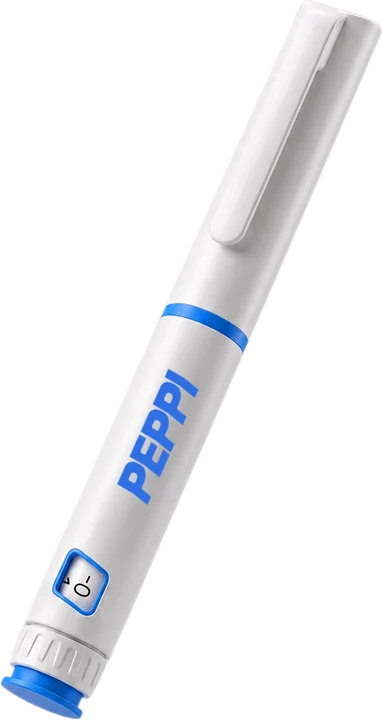
Peppi's GHK-Cu peptide pen holds 50 mg of GHK-Cu, a copper peptide studied for its role in skin regeneration and repair. Peppi lists collagen support, skin renewal and healthy aging as areas it may support. It's a prescription, not a cosmetic. A licensed clinician reviews your intake and personalizes your dose, and you set that dose with the pen's twist-to-dose selector.
Be clear on the evidence before you start. The collagen findings above come mostly from creams and lab studies, and research on injected GHK-Cu in people is still limited. It's one more way to approach how to stimulate collagen production, added to the habits above rather than replacing them. Peppi recommends committing 4 to 6 months, because peptide therapy is cumulative.
If you also want recovery support, Peppi's GLOW pen pairs 50 mg of GHK-Cu with 10 mg of BPC-157 and 10 mg of TB-500. Every batch is third-party tested for potency, sterility, pH and endotoxins before it ships, and you can look up Peppi's batch test results by lot number.
Put together, that's how to boost collagen production from both sides: better inputs and less breakdown.
TipA GHK-Cu pen is $149 for the first month on a subscription, then $239 a month after that. If a clinician doesn't approve your prescription, you get a 100% refund.
Collagen production questions
Frequently asked questions
Not sure which pen fits your skin goals? Peppi's peptide goal quiz takes under 2 minutes.
Do Collagen Supplements Work?
Possibly, for some people. Cleveland Clinic notes there are few randomized controlled trials, and the ones done suggest collagen peptides may improve skin hydration and elasticity. The FDA doesn't regulate collagen supplements, and many studies are funded by the industry, so treat them as optional and keep diet and sunscreen first.
How Long Does It Take to Rebuild Collagen?
Think in months. In one 12-month tretinoin study, skin biopsies showed no significant dermal change at 6 months and new collagen fibers at 12. The GHK-Cu cream studies ran one to three months. For its peptide pens, Peppi recommends committing 4 to 6 months, because results build gradually and onset varies from person to person.
What Breaks Down Collagen in the Skin?
The biggest drivers you control are UV light, smoking and a high-sugar diet. UV cuts new collagen and speeds breakdown, smoking damages collagen and elastin, and sugar forms advanced glycation end products that make collagen brittle. Age lowers production too, and women see a significant drop after menopause.
*These statements have not been evaluated by the Food and Drug Administration. Peppi peptides are dispensed only with a prescription.