
In this guide
Skin elasticity is your skin's ability to stretch and spring back. Much of it comes from the dermis, the layer under the surface that's rich in collagen and elastic fibers. With age, skin gets thinner, drier and less elastic, and the dermis loses thickness.
No single product puts all of that back. What the research supports is a set of habits that slow the damage and support repair, plus a few treatments with real data. This guide covers seven, ending with where Peppi's GHK-Cu pen fits and where the evidence on it is still thin.
What you need to improve skin elasticity
Start with the basics
- Broad-spectrum sunscreenWorn every morning on your face, neck and hands.
- A retinoidTretinoin by prescription or retinol over the counter, used in the evening.
- Fruit and vegetablesYour main source of vitamin C, which your skin uses to make collagen.
- A clinicianFor prescription options like tretinoin or a GHK‑Cu pen.
- PatienceSkin changes are measured in months and years.
The short version of how to improve skin elasticity is to slow the damage first and support repair second. Loss of skin elasticity comes from two kinds of aging. Age thins the dermis even in skin the sun never reaches, while years of sun leave thickened, tangled and degraded elastic fibers in the skin you show the world.
Sun is the part you can control most, so the steps start there and say plainly how strong each one's evidence is.
Steps to improve skin elasticity
Protect, feed, then treat
- Step 1
Daily sunscreen for firmer skin
Wear it every single morning
Daily sunscreen is the one habit here tested for prevention in a long randomized trial. In a randomized sunscreen trial in Nambour, Australia, 903 adults under 55 were assigned to daily broad-spectrum sunscreen or to their usual, as-needed use.
After 4.5 years, the daily group showed no detectable increase in skin aging. Skin aging was 24% less in the daily group than in the as-needed group, based on changes in skin surface texture graded by assessors who didn't know who was in which group. The trial measured aging rather than elasticity itself, but sun damage is what leaves the elastic fibers in exposed skin thickened and tangled.
That's the first answer to how to increase skin elasticity: stop losing it so fast.
TipKeep the bottle next to your toothbrush, so sunscreen rides along with a habit you already have every morning.
- Step 2
A retinoid at night
Add vitamin A before bed
Retinoids are vitamin A compounds, and tretinoin is the most widely studied of them for sun-aged skin, according to a 2006 review of retinoids for skin aging. It's a prescription drug, and the FDA label for a tretinoin cream approved for fine facial wrinkles calls for using it in the evening.
Some of the studies in that review measured elasticity directly. An experimental high-strength tretinoin solution improved elasticity, hydration and fine wrinkling in 50 women within 4 to 6 weeks, and topical retinaldehyde raised skin elasticity in a separate 40-person trial against a plain base.
Retinol, the over-the-counter choice, has been sold in cosmetics since 1984, causes far less redness and irritation than tretinoin and works once your skin converts it into retinoic acid.
Good to knowRetinoids can cause redness, burning and peeling, and they make skin more sensitive to sun. Tretinoin's FDA label says not to use it if you're pregnant or trying to become pregnant, and the 2006 review advises stopping topical retinoids in pregnancy as a precaution. Unless your doctor says otherwise, skip retinoids, retinol included, while pregnant or trying, and talk to a clinician before starting tretinoin.
- Step 3
Foods for skin elasticity
Build meals around fruit and vegetables
The best evidence on foods for skin elasticity comes from diet surveys, which show patterns rather than proof. In a 2007 analysis of US diet survey data on 4,025 women aged 40 to 74, whose skin was examined by dermatologists, higher vitamin C intake went with fewer wrinkles and less dryness.
Linoleic acid, an omega-6 fat, was tied to less dryness and less thinning of the skin. Eating more total fat and more carbohydrate went the other way, with higher odds of wrinkles and thin skin.
Produce also turns up in research on sagging, where a review of vitamin C and skin lists better skin tightness in people who eat more fruit and vegetables.
- Step 4
Vitamins for skin elasticity
Get your vitamin C from food
Of all the vitamins for skin elasticity, vitamin C has the clearest role. Your skin stores it at high levels and uses it to stimulate collagen production and to help defend against UV damage.
More isn't automatically better. Supplements are only expected to raise the vitamin C in your skin if your blood levels were low to start with. If you already eat plenty of produce, a pill may add little.
Beta-carotene supplements, a plant form of vitamin A, were also tested in the Australian sunscreen trial and showed no overall effect on skin aging. The authors said more research is needed to rule out a benefit or a harm.
TipBefore buying a high-dose vitamin C supplement, ask a clinician whether you're actually low. Once your blood levels are full, extra vitamin C doesn't seem to raise skin levels any further.
- Step 5
Collagen for skin elasticity
Treat collagen powder as optional
Collagen for skin elasticity is the most marketed habit on this list and one of the least settled. A 2025 meta-analysis of collagen supplement trials pooled 23 randomized trials with 1,474 people, and taken together they showed better hydration, elasticity and wrinkles.
The picture changed once the authors sorted the trials. Studies without drug company funding found no effect on hydration, elasticity or wrinkles, and the high-quality trials found no significant effect either.
Their conclusion was that there's currently no clinical evidence to support collagen supplements for preventing or treating skin aging. A scoop in your coffee is still protein. Just don't count on it to firm your skin.
- Step 6
Copper peptides for skin
Know what GHK-Cu has shown
GHK-Cu is the best known of the copper peptides for skin. GHK occurs naturally in human blood, and a GHK-Cu gene data review reports that levels fall with age, from about 200 ng/mL at age 20 to about 80 ng/mL by 60. Read that review with its source in mind: its lead author works for a company that sells copper peptide skin care, and much of the skin data it cites comes from meeting reports and pilot studies.
In a lab study the review cites, GHK-Cu increased both elastin and collagen production by human skin cells called fibroblasts. The review also cites a small German pilot study of a copper peptide cream on aged skin that reported thicker skin, better hydration and higher elasticity.
The human case for GHK Cu for skin is small and short. The review's strongest examples are a few short cream and serum trials in women that reported fewer wrinkles than the base product alone. A 2026 systematic review of GHK-Cu in aesthetic medicine found only 2 randomized trials among the 20 studies it included, with the rest done in labs and animals, and called for larger, controlled trials.
If you're comparing peptides for skin tightening, keep the form in mind. Every human trial above tested a product applied to the skin. None of them tested an injection.
Good to knowThere's little published data on GHK-Cu injections in people, so set your expectations with your clinician before you start.
- Step 7
The GHK-Cu peptide pen
Add a prescribed pen last
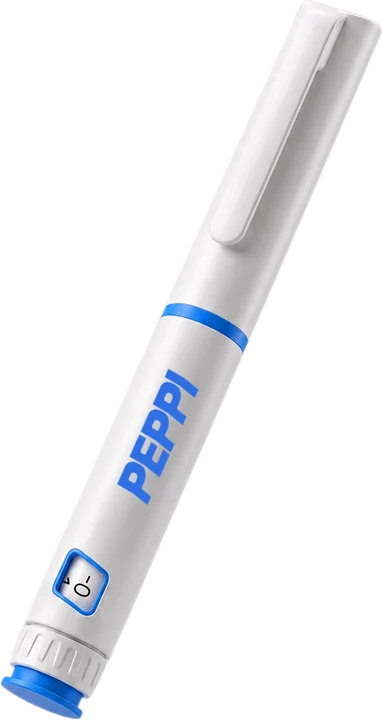
Once the habits above are in place, Peppi's GHK-Cu peptide pen is the prescription route. Each pen holds 50 mg of GHK-Cu, a naturally occurring copper peptide studied for its role in collagen production, skin renewal and healthy aging.
A licensed clinician reviews your intake and personalizes your dose, which you set with the pen's twist-to-dose selector. Your clinician can also tell you whether a GHK Cu peptide pen makes sense next to a retinoid or anything else you use. Peppi recommends committing 4 to 6 months, since peptide therapy is cumulative.
Peppi's GLOW pen is Peppi's glow peptide blend for people who also want recovery support. It pairs the same 50 mg of GHK-Cu with 10 mg of BPC-157 and 10 mg of TB-500.
Every batch of both pens is third-party tested for potency, sterility, pH and endotoxins before it ships, and you can look up your pen's lot number in Peppi's batch test results.
One verified buyer, Sarah T., wrote about her GHK-Cu pen: "It took a month or two, but my face feels significantly plumper and the fine lines look softer." That's one person's experience, not proof, and responses vary.
TipGHK-Cu starts at $149 for the first month on a subscription, then $239 every 28 days. GLOW starts at $189, then $303. If a clinician doesn't approve your prescription, you get a 100% refund.
Skin elasticity questions
Frequently asked questions
Not sure where a peptide fits in your routine? Start with Peppi's peptide goal quiz.
Can Lost Skin Elasticity Come Back?
Partly, in some studies. Retinoid trials have measured better elasticity, and a small pilot study of a copper peptide cream reported higher elasticity and thicker skin, but none show a full return to younger skin. Even the FDA label for a prescription tretinoin cream says it doesn't repair sun-damaged skin or reverse photoaging. Daily sunscreen, which protects what you have, is the best-tested part of the plan.
How Long Does It Take to Improve Skin Elasticity?
Expect months, not weeks. The sunscreen benefit in the Australian trial was measured over 4.5 years. Standard tretinoin studies ran 6 to 12 months, and improvement kept building after 6 months. The GHK-Cu cream and serum trials described in the 2018 review ran 8 to 12 weeks. For its peptide pens, Peppi recommends committing 4 to 6 months, and how fast you respond varies from person to person.
Is GHK-Cu Better Than Retinol for Firmness?
We couldn't find a trial comparing GHK-Cu with retinol on firmness. The closest is a 1998 pilot study, cited in the 2018 review, in which a GHK-Cu cream raised collagen in more women than prescription tretinoin did, without measuring firmness. Retinoids have the far larger evidence base, and tretinoin has an FDA label for fine facial wrinkles. A clinician can help you decide whether one, the other or both suits your skin.
*These statements have not been evaluated by the Food and Drug Administration. Peppi peptides are dispensed only with a prescription.