
In this guide
Mitochondria are the small structures inside almost every cell that combine oxygen with fuel from food to make energy. Muscle and nerve cells have especially high energy needs, so they rely heavily on working mitochondria.
Your mitochondria also respond to how you live. Muscle can build more of them and make the ones it has work better, mostly in response to exercise. This guide starts with the habits that have human research behind them, then covers what early studies show about MOTS-c, a peptide encoded in your mitochondria's own DNA.
What you need for better mitochondrial health
Movement first, then fuel
- Regular exerciseEndurance and interval training both raise mitochondrial content or function in human muscle studies.
- Enough food & B vitaminsRiboflavin and niacin help your body turn food into usable energy.
- A steady body clockMuscle mitochondria follow a daily rhythm, and light and regular sleep keep your body clock on time.
- A few weeks of patienceMeasurable changes in muscle show up over weeks, not days.
- A doctor for lasting fatigueOngoing tiredness has common medical causes worth ruling out first.
Good mitochondrial health mostly comes down to giving your muscles a reason to adapt.
A 2018 review of human training studies links a sedentary lifestyle to metabolic disorders tied to weaker mitochondria, and notes that endurance training can raise both how many mitochondria you have and how well they work.
Mitochondrial dysfunction can also mean a real medical condition. According to MedlinePlus on mitochondrial diseases, these conditions are caused by genetic mutations and usually begin before age 20. A slow afternoon on its own doesn't point to one, and only a doctor can diagnose it.
If you're searching how to increase energy levels because fatigue won't lift, see a doctor before you change anything else. Anemia, thyroid problems, sleep apnea, depression and some medicines can all cause it, and each needs its own treatment.
Steps to boost mitochondria
Move first, fine-tune later
- Step 1
Easy aerobic cardio most days
Build a steady aerobic base
If you want to know how to increase mitochondria, start with regular aerobic exercise. A 2018 review of human muscle studies found that training volume may be a critical factor in how much mitochondrial content rises, while exercise intensity matters more for how well those mitochondria work.
Zone 2 training is one popular way to build that volume. There's no single official definition, but it's commonly described as an easy, steady effort where you can still talk in full sentences, like brisk walking or easy cycling.
Because it's gentle, you can do it most days. U.S. activity guidelines call for at least 150 to 300 minutes of moderate aerobic activity each week, and easy cardio is a simple way to reach that without wearing yourself down.
TipOnce easy cardio feels routine, a few harder intervals add the intensity side. If you have a heart condition or haven't exercised in a while, check with your doctor first.
- Step 2
Strength training twice a week
Keep the muscle you have
Strength training does a different job. In a 12-week study of younger and older adults, resistance training increased lean mass and leg strength in both age groups but didn't significantly raise mitochondrial respiration. Interval training raised it by 49% in adults aged 18 to 30 and by 69% in adults aged 65 to 80.
A program that combined cycling with weight lifting built strength and lean mass in both age groups, but it raised mitochondrial respiration significantly only in the younger adults.
If your question is how to improve mitochondrial function, lifting alone is the weaker tool. A 2017 review found that heavy resistance exercise can stimulate mitochondrial biogenesis and respiratory function in some studies, though the authors call its exact effect debatable.
Lifting still belongs in any plan for how to boost mitochondria. U.S. guidelines recommend muscle-strengthening activity, like weights or push-ups, at least 2 days a week, for strength and lean mass on top of what cardio does.
- Step 3
Foods that boost mitochondria
Cover the vitamins energy runs on
No single food builds new mitochondria, whatever the lists of foods that boost mitochondria promise.
What your diet can do is supply the nutrients your cells use to turn food into energy. Riboflavin, or vitamin B2, helps release energy from carbohydrates, proteins and fats. You'll get it from eggs, dairy, lean meats, legumes and green leafy vegetables.
Niacin, or vitamin B3, is also important for changing food into energy, and fish, poultry, peanuts and enriched grains all supply it.
- Step 4
Sleep & morning daylight
Keep your body clock on time
Your muscle mitochondria run on a daily schedule. In a 2016 study of lean, healthy adults, researchers took muscle biopsies at five points across 24 hours. Mitochondrial capacity showed a clear day-night rhythm, lowest at 1 PM and highest at 11 PM.
Light and dark have the biggest influence on your body clock, according to the NIH. Morning light is one of the signals your body uses to start waking up, and dimmer screens at night help too, since light from devices can confuse your body clock.
Experts recommend 7 to 9 hours of sleep a night for adults. The study authors speculate that a disrupted body clock may contribute to poorer metabolic health, but that hasn't been proven, so treat a steady sleep schedule as good for your body clock rather than a proven mitochondria boost.
TipShift work and travel across time zones both throw off the sleep-wake cycle. If either is part of your life, protect a regular sleep window wherever you can.
- Step 5
Supplements for mitochondria
Choose supplements carefully
Evidence on supplements for mitochondria varies widely by product, and none of them replaces the steps above.
CoQ10 is naturally present in your body. It's also a key part of the mitochondrial respiratory chain. Even so, the NIH's summary of CoQ10 research calls the evidence in heart failure inconclusive and says the overall evidence doesn't support it for statin-related muscle pain.
Creatine is one of the most popular sports supplements, and most of its research is on performance. It helps muscles regenerate ATP, the cell's energy currency, during all-out efforts. A 2017 sports nutrition position stand calls creatine monohydrate the most effective nutritional supplement available to athletes for high-intensity exercise capacity and lean mass during training.
NAD precursors are newer. In a placebo-controlled crossover trial of 30 healthy middle-aged and older adults, 6 weeks of nicotinamide riboside was well tolerated and raised NAD+ in blood cells by about 60%, but it didn't change exercise capacity.
Good to knowSupplements can interact with medicines. CoQ10, for example, may interact with the blood thinner warfarin and with insulin, so check with your clinician before you add one.
- Step 6
Mitochondrial peptides like MOTS-c
Ask about a prescribed MOTS-c pen
MOTS-c belongs to a family called mitochondrial peptides, small proteins encoded in mitochondrial DNA instead of the cell's nucleus. In the original MOTS-c study, published in 2015, researchers described a 16-amino-acid peptide whose primary target appears to be skeletal muscle.
Most of the MOTS c benefits you'll read about come from animals. In that study, MOTS-c treatment in mice on a high-fat diet limited weight gain and insulin resistance. In 12-month-old mice, 7 days of treatment restored muscle insulin sensitivity to levels seen in young mice.
A 2021 study later tied it to exercise, finding that a single exercise session raised MOTS-c nearly 12-fold in the muscle of 10 young men, and that treatment late in life improved grip strength and walking in old mice.
Be clear on what that means for you. Almost all MOTS-c treatment research so far is in mice and cells, it isn't FDA-approved, and it doesn't replace the habits above.
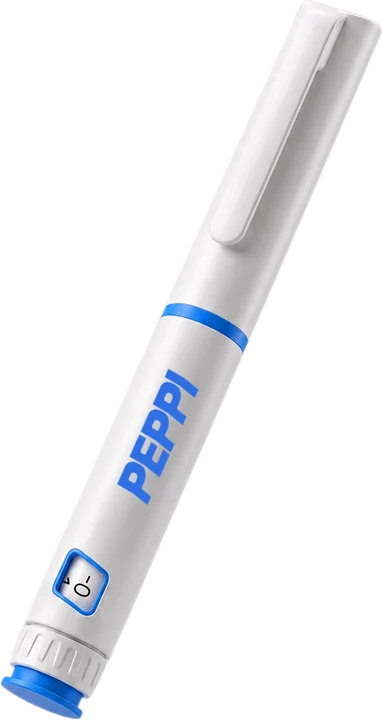
If you're curious about mitochondrial peptides like MOTS-c, Peppi's pen holds 40 mg of MOTS-c, a peptide being studied for its potential role in metabolism, cellular energy, endurance and insulin sensitivity. A licensed clinician reviews your intake and personalizes your dose, which you set with the pen's twist-to-dose selector.
Peppi pairs it with the CJC + Ipamorelin pen, a growth-hormone-targeting combination designed to support muscle development, sleep and recovery. Every batch is third-party tested for potency, sterility, pH and endotoxins, and you can look up Peppi's batch test results by lot number.
Kevin L., a verified buyer, described his experience this way: “I was just dragging through the afternoons at work a bit. Adding MOTS-C gave me very steady clean energy and an extra dose of motivation. I’m finally pushing past plateaus and feel like I have way more energy.” Results vary from person to person, and Peppi recommends committing 4 to 6 months because peptide therapy is cumulative.
TipA MOTS-c pen is $224 for the first month on a subscription, then $359 a month after that. If a clinician doesn't approve your prescription, you get a 100% refund.
Mitochondria & energy questions
Frequently asked questions
Not sure which pen fits your energy goals? Peppi's peptide goal quiz asks a few questions and tells you where to start.
What Are the Signs of Mitochondrial Dysfunction?
Mitochondrial disease is a medical diagnosis, and fatigue alone doesn't point to it. These diseases are caused by genetic mutations, usually start before age 20 and vary widely, though muscle and nerve problems are common. Everyday tiredness has many other possible causes, from anemia to sleep apnea. If fatigue lasts, or comes with fever, weight loss or poor sleep, see your doctor instead of trying to self-diagnose.
How Long Does Mitochondrial Biogenesis Take?
Muscle starts adapting within weeks. In one study, six interval sessions over 2 weeks raised markers of mitochondrial capacity in the thigh muscle of young men. Over 12 weeks, interval training raised mitochondrial respiration by 49% in younger adults and 69% in older adults. For its MOTS-c pen, Peppi recommends committing 4 to 6 months, because peptide therapy is cumulative and response varies.
What Does MOTS-c Do?
MOTS-c is a 16-amino-acid peptide encoded in mitochondrial DNA. Its main target appears to be skeletal muscle, where mouse and cell studies show it affects how the body uses glucose and energy. Exercise raises its levels in human muscle and blood. Treatment research is almost all in mice and cells, and it isn't FDA-approved, so a clinician should decide whether it fits your goals.
*These statements have not been evaluated by the Food and Drug Administration. Peppi peptides are dispensed only with a prescription.