A sprain is a stretched or torn ligament, and most of the recovery is in your hands: an exam, a few days of protection, early movement and rehab you finish. This guide walks through those steps in order, then covers what the research on recovery peptides shows and how a licensed clinician decides whether a ready-to-use, pre-filled Peppi pen is appropriate for you.
Faster, in practice, means not losing weeks to a missed fracture, a stiff joint or a second sprain. The American Academy of Orthopaedic Surgeons (AAOS) calls incomplete rehabilitation the most common cause of chronic ankle instability after a sprain.
What you need to heal a torn ligament
Five things to line up
- A diagnosis and a gradeAAOS grades sprains from 1, a slight stretch, to 3, a complete tear, and the grade sets the plan.
- Short-term supportA wrap, a brace, a walking boot or a short cast, depending on that grade.
- Ice, a bandage and a pillowThe tools for swelling in the first two days.
- A rehab planRange of motion first, then strength, then balance work.
- TimeFrom 2 weeks for a minor ankle sprain up to 6 to 12 weeks for a more severe one, by AAOS's estimate.
How to heal ligaments faster comes down to four habits: get a diagnosis, protect the joint, start moving early and finish the rehab. Peptides come last, with what the research does and does not show.
A sprained ligament and a torn ligament sit on one scale. MedlinePlus on sprains & strains defines a sprain as a stretched or torn ligament, the tissue that connects bones at a joint. The National Institute of Arthritis and Musculoskeletal and Skin Diseases (NIAMS) lists ankles, knees and wrists as the areas most vulnerable.
Tendon vs ligament matters because the injuries carry different names. A ligament injury is a sprain. A stretched or torn muscle or tendon is a strain, and tendons connect muscle to bone.
Steps to heal ligaments faster
Eight steps, in order
- Step 1.
Get a sprained ligament checked
Rule out a fracture first
Start with an exam if the injury is more than mild. Severe ankle sprains can bring pain, bruising and swelling similar to a fracture, AAOS notes, which makes the two hard to tell apart.
NIAMS says to see a health care provider for severe pain, swelling or bruising, for pain and swelling that do not go away after a few days, if you cannot tolerate any weight on the area, or for an obvious deformity.
An exam also gives you a grade. AAOS sorts ankle sprains this way:
Grade Ligament damage Instability on exam Grade 1 Slight stretching and microscopic tearing of the fibers None Grade 2 Partial tearing Slight looseness Grade 3 Complete tear A lot of it TipNote how it happened and whether you felt a pop. AAOS calls an ankle sprain largely a clinical diagnosis, based on how the injury happened, your symptoms and the exam.
- Step 2.
Protect & rest the joint
Rest it for a day or two
Stop the activity that hurt it. NIAMS is blunt that you should not try to work through the pain of an injury, because continuing may cause further harm. Its rest advice: limit activities that use the injured area for at least a day or two, and try to keep weight off the joint.
Support depends on the grade. For ankle sprains, AAOS describes a removable walking boot or brace for Grade 2 and says Grade 3 sprains may require a short leg cast or cast-brace for 10 to 14 days.
Rest has an end date. Most people only need immobilization for a limited time, per NIAMS, and AAOS typically recommends early weightbearing as tolerated even in the first phase.
- Step 3.
Ice, compression & elevation
Bring the swelling down
Ice, compression and elevation target swelling, and they start right away. NIAMS gives the specifics:
- Ice: 20 minutes at a time, four to eight times a day, wrapped in a towel and never for longer than 20 minutes.
- Compression: an elastic bandage, not so tight that it cuts off the circulation.
- Elevation: the ankle, knee, elbow or wrist on a pillow, above the level of your heart.
Skip heat at first. Heat right after an injury tends to increase inflammation and swelling, NIAMS says, and belongs no earlier than 72 hours in.
- Step 4.
Early movement & physical therapy
Move early, with guidance
Early, controlled movement has randomized trial data behind it. In a 2010 BMJ trial, 101 patients with a Grade 1 or 2 ankle sprain were assigned to early therapeutic exercise or to standard protection, rest, ice, compression and elevation.
Ankle function was better in the exercise group at week 1 and week 2. Reinjury rates were identical, at 4% in each group.
That trial covered mild and moderate ankle sprains, not complete tears or other joints.
Once the injury has healed, NIAMS says, a physical therapist or physiatrist builds a rehab plan aimed at rebuilding strength and range of motion, with exercises you do at home as well as in the office.
How long does a ligament take to heal? For ankles, AAOS says its three-phase program may take just 2 weeks to complete for minor sprains, or up to 6 to 12 weeks for more severe injuries.
TipMotion comes before resistance. To prevent stiffness, AAOS starts with range-of-motion or controlled ankle movements without resistance.
- Step 5.
Collagen for ligaments
What gelatin & vitamin C showed
Evidence on collagen for ligaments in this guide comes from one small study. It measured a blood marker in healthy men, not injured joints.
In a 2017 American Journal of Clinical Nutrition crossover trial, eight healthy men drank vitamin C-enriched gelatin or a placebo an hour before six minutes of rope-skipping, three times a day for three days. With the larger of two gelatin servings, a blood marker of collagen synthesis doubled.
Nobody in the study had a ligament injury. The authors concluded that adding gelatin to an intermittent exercise program "could play a beneficial role in injury prevention and tissue repair."
TipGelatin and collagen powders are dietary supplements, and Peppi does not sell them. If you take one, tell your clinician, along with any other supplement.
- Step 6.
How to strengthen ligaments
Finish the balance work
Rehab is how to strengthen ligaments after a sprain, and stopping early undoes it. AAOS warns that if you stop the strengthening exercises, the injured ligament will weaken and leave you at risk of future sprains.
Balance training was tested in a 2009 BMJ randomized trial. Its 522 athletes, aged 12 to 70, had sprained an ankle within the previous two months. All received usual care, and half added an eight-week balance program at home.
Over the next year, 22% of the training group reported another sprain. In the control group it was 33%.
AAOS gives an example of a balance exercise: stand on the affected foot with the other foot raised and your eyes closed. Ligament healing time and rehab run together: AAOS warns that going back to sports before the ankle heals and is rehabilitated can mean spraining it again.
TipReturn in order. AAOS brings back activities without turning or twisting first, then sports with sharp, sudden turns such as tennis, basketball or football.
- Step 7.
Peptides for ligament repair
Where the research stands
Research on peptides for ligament repair is early, and for BPC-157 nearly all of it is in animals. Peppi's product page describes BPC-157 as "a lab-made peptide of 15 amino acids, based on a fragment of a protein first isolated from human gastric juice."
A 2025 systematic review in HSS Journal covered 36 studies of BPC-157 in orthopedic sports medicine, 35 of them preclinical. In those animal models, BPC-157 improved functional, structural and biomechanical outcomes in muscle, tendon, ligament and bone injuries.
In one of them, a 2010 Journal of Orthopaedic Research study, rats had a knee ligament surgically cut and were followed for 90 days. Its Zagreb authors reported functional, biomechanical and tissue-level improvements with BPC-157.
Work on peptides for tendon repair is at the same stage. In a 2026 study of 32 rats with a repaired Achilles tendon, the authors linked both BPC-157 and TB-500 to better tendon structure at four weeks, though the BPC-157 group alone did not reach statistical significance on the total tissue scores and only TB-500 showed a significant gain in strength. The combination showed no added benefit over either peptide alone, and the authors called the work exploratory.
Animal results do not always carry over to people. The HSS Journal review found one clinical study, a retrospective report on knee pain, and no study of adverse effects in humans.
Peppi's Wolverine, KLOW and BPC-157 pens are compounded prescription peptides and are not FDA-approved. If you compete in a tested sport, WADA's 2026 Prohibited List bans BPC-157 (section S0) and TB-500 (section S2.3) at all times.
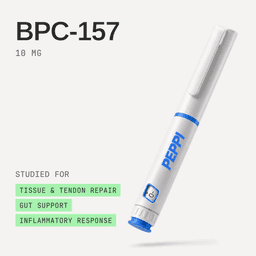
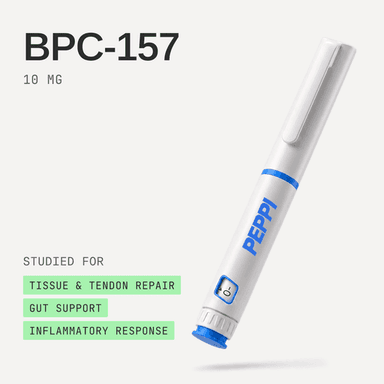
Peppi's BPC-157 pen holds 10 mg of BPC-157. Peppi lists it as studied for tissue and tendon repair, gut support and anti-inflammatory support, and a licensed clinician determines whether it is appropriate for you.
- Step 8.
The Wolverine stack
Two recovery peptides, one pen
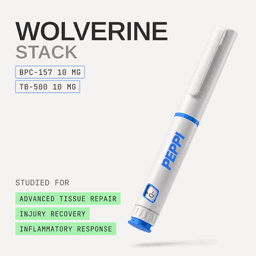
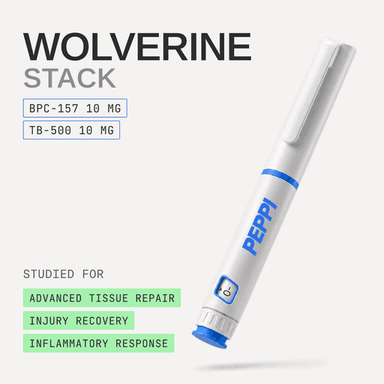
The Wolverine stack pairs BPC-157 with TB-500. Peppi's Wolverine stack pen holds 10 mg of each in a one-month supply, and Peppi lists it as studied for advanced tissue repair, injury recovery and anti-inflammatory support.
TB-500 is a synthetic version of a short active region of the protein thymosin beta 4, as a 2012 doping-control study describes it. Peppi's Wolverine page states: "No human trial has tested BPC-157 and TB-500 together."
What Peppi adds is the process around the peptides. Your pen arrives pre-filled with a twist-to-dose selector, so there is no reconstituting or mixing. In most cases a licensed clinician reviews your information within 24 hours, determines whether treatment is appropriate and, if so, sets your dose.
Every batch is third-party lab tested before it ships. You can look up Peppi's batch test results by the lot number printed on your pen label.
Jason B., a verified buyer, wrote: "I started Wolverine because I had a few nagging things that just weren't getting better. It wasn't some overnight change, but after a few weeks I felt less beat up and could train more consistently again. The pen was also way easier than I expected." That's one person's experience, and results vary.
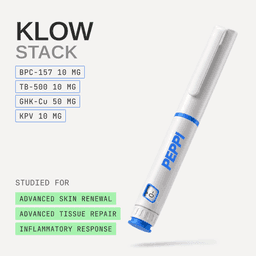
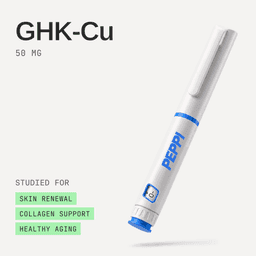
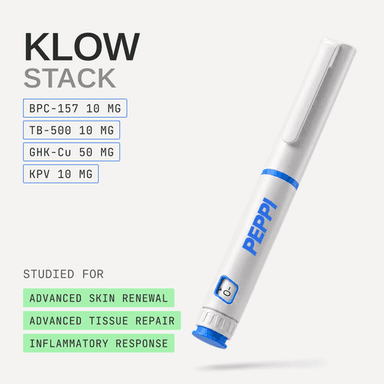
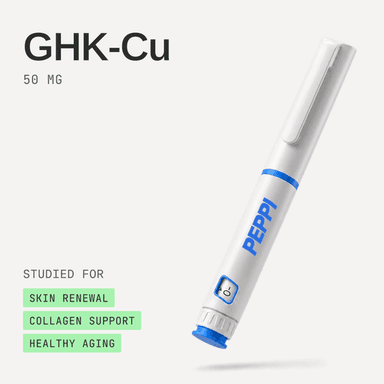
With skin goals on the list too, Peppi's KLOW pen carries the same 10 mg of BPC-157 and 10 mg of TB-500, plus 50 mg of GHK-Cu and 10 mg of KPV.
Not sure which recovery pen fits your goals?
Take the QuizA clinician licensed in your state reviews your intake and decides whether any pen fits your goals.
Good to knowPricing today: the Wolverine pen is $379 one-time, or 50% off your first month by subscription. Peptide therapy is cumulative, and Peppi recommends committing 4 to 6 months. If your prescription isn't approved, you get a 100% refund.
Ligament healing questions
Three common questions
Questions about pens, dosing or shipping? Those answers live in the Peppi FAQs.
How Long Does a Ligament Take to Heal?
It depends on the grade and the joint. For ankle sprains, AAOS says its three-phase treatment program may take just 2 weeks for minor sprains, or up to 6 to 12 weeks for more severe injuries. Knees can run longer: AAOS says recovery and rehabilitation for a partially torn ACL usually lasts at least 3 months. Ankle pain that continues past 4 to 6 weeks may be a chronic sprain, AAOS adds, and an ankle that stays swollen or painful for several weeks may need to be seen by a medical professional.
What Is the Difference Between a Tendon & a Ligament?
A ligament connects bone to bone at a joint. A tendon connects muscle to bone. MedlinePlus defines a sprain as a stretched or torn ligament and a strain as a stretched or torn muscle or tendon. Early treatment is similar for both: rest, ice, compression and medicines, then exercise and physical therapy.
Can a Torn Ligament Heal Without Surgery?
Often, yes. NIAMS says the majority of musculoskeletal sports injuries do not require surgery. AAOS says nearly all isolated low ankle sprains can be treated without it, and that even a complete Grade 3 tear will heal without surgical repair if it is immobilized and rehabilitated appropriately. A complete ACL tear in the knee is a different case: AAOS says complete tears usually require surgical reconstruction, because without it the knee tends to feel unstable. Partial ACL tears may be treated without surgery through physical therapy. An orthopedic exam tells you which case is yours.
These peptides are not FDA-approved and are dispensed only with a prescription.
Peptide guides from Peppi
Keep reading