You can build muscle after 40. A 2011 meta-analysis pooled 49 resistance training studies in 1,328 adults aged 50 and older. Average gain: 1.1 kg of lean body mass, about 2.4 pounds, with bigger gains for people who did more training.
At 40 the work is the same as at 25, with two changes: each meal needs more protein, and recovery has to be planned. This guide covers those habits first, then where growth hormone peptides fit, including Peppi's ready-to-use, pre-filled pens.
What you need to build muscle in midlife
Four inputs, one plan
- Progressive resistance trainingTwo or three sessions a week that get heavier over time.
- Protein at every mealOlder muscle needs a bigger dose per meal to switch on muscle building.
- Recovery7 to 9 hours of sleep a night.
- Clearance before you startHarvard Health says to check with your doctor first and have a qualified trainer supervise your first workouts.
Building muscle after 40 takes progressive resistance training, more protein per meal than you needed at 25, enough sleep and months of patience. No peptide replaces any of it.
Muscle loss after 40 is slow but real. Harvard Health on muscle mass said in 2016 that age-related muscle loss, called sarcopenia, starts after 30 at as much as 3% to 5% per decade.
Part of the reason is anabolic resistance, which changes how to build muscle after 40. In a 2015 retrospective analysis in the Journal of Gerontology, healthy men around age 71 needed about 0.40 grams of protein per kilogram of body weight in one meal to fully stimulate muscle protein synthesis. Men around 22 needed about 0.24.
Steps to build muscle as you age
Six steps, in order
- Step 1.
Strength training for older lifters
Lift a little heavier over time
Strength training after 40 comes first, because the other steps have nothing to build on without it. Peptides come last, as an option a clinician weighs once the habits are in place.
Dr. Thomas W. Storer of Brigham and Women's Hospital tells Harvard Health that progressive resistance training is the best way to build muscle at any age: "It takes work, dedication, and a plan, but it is never too late to rebuild muscle and maintain it."
Progressive means the load rises as you get stronger. Harvard Health's starting template is 8 to 10 exercises covering every major muscle group, two or three workouts a week. Each set runs 12 to 15 reps at an effort of about 5 to 7 out of 10. Once that feels routine, progress one of two ways: add a second and third set, or drop to 8 to 12 reps with more weight.
In the 2011 meta-analysis of adults aged 50 and older, higher-volume programs produced larger lean mass gains.
- Step 2.
A weekly workout plan
Three full-body days a week
A workout plan for men over 40 can run on two or three lifting days plus some walking. U.S. Physical Activity Guidelines call for muscle-strengthening activity at least 2 days each week, plus 150 to 300 minutes of moderate aerobic activity such as brisk walking. A sample week on that template, with three lifting days:
Day Session Notes Monday Full body A: squat or leg press, bench press or push‑up, row, hip hinge, plank 2 to 3 sets of 8 to 12 reps Tuesday Brisk walk, 30 to 45 minutes Counts toward the weekly aerobic minutes Wednesday Full body B: lunge or step‑up, overhead press, lat pulldown or pull‑up, hip thrust, loaded carry 2 to 3 sets of 8 to 12 reps Thursday Rest or an easy walk Recovery day Friday Full body A again, a little heavier Move one lift up by a small amount Weekend One walk, one full rest day Catch up on sleep This same plan answers how to build muscle after 50. Exercises stay the same, starting weights change.
- Step 3.
How much protein to build muscle
Spread protein across three meals
How much protein to build muscle after 40 depends on age and training. In 2013 the PROT-AGE Study Group, an international panel of geriatric and nutrition researchers, recommended 1.0 to 1.2 grams of protein per kilogram of body weight a day for adults over 65. For those who exercise, it advised 1.2 grams or more. Harvard Health puts the range for older lifters at 1 to 1.3 grams per kilogram, about 79 to 103 grams a day for a 175-pound man.
There is a ceiling. A 2018 British Journal of Sports Medicine meta-analysis of 49 trials and 1,863 healthy adults found that protein added to strength training increased lean mass and strength. Intakes above about 1.6 grams per kilogram a day added nothing further, and the benefit shrank with age.
Per meal matters too. In a 2014 crossover study of 8 healthy adults, about 30 grams of protein at each of three meals raised 24-hour muscle protein synthesis 25% more than packing most of it into dinner. Two of its authors disclosed beef-industry speaking fees. Combine that with the 0.40 grams per kilogram per meal threshold above, and a man around 70 weighing 180 pounds lands at about 33 grams at breakfast, lunch and dinner.
Good to knowOne exception in the PROT-AGE paper: severe kidney disease, where protein may need to be limited. That is a question for your doctor.
- Step 4.
Creatine & recovery days
Creatine, then planned rest
Creatine is one supplement with pooled trial data in older lifters. A 2017 meta-analysis pooled 22 randomized trials in 721 men and women with average ages of 57 to 70. Creatine taken during 7 to 52 weeks of resistance training added 1.37 kg more lean tissue than placebo and improved chest press and leg press strength.
Recovery days belong to this step too. The sample week in step 2 never puts two lifting days back to back: Tuesday, Thursday and the weekend are walks or full rest.
TipCreatine is a dietary supplement, not a prescription, and Peppi does not sell it. If you take it, tell your clinician, along with any other supplement.
- Step 5.
Sleep for muscle repair
Sleep 7 to 9 hours a night
One short night changes muscle chemistry. In a 2021 randomized crossover study in Physiological Reports, 13 healthy young adults skipped one full night of sleep. Next day, their muscle protein synthesis was 18% lower, cortisol 21% higher and testosterone 24% lower than after a normal night.
One night in young adults shows a mechanism, not what years of short sleep do to you. NHLBI recommends adults sleep between 7 and 9 hours a night.
- Step 6.
Growth hormone peptides in midlife
Consider peptides last, with a clinician
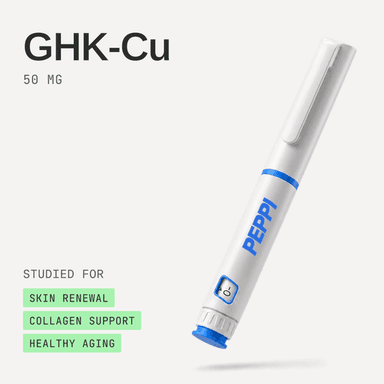
Among peptides for men over 40, the two Peppi pens tied to muscle are growth hormone secretagogues, peptides that prompt your pituitary to release more of your own growth hormone: Tesamorelin and CJC + Ipamorelin. You can only be prescribed one growth hormone peptide at a time, so Tesamorelin and CJC + Ipamorelin are never prescribed together. Peppi's Tesamorelin, CJC + Ipamorelin and Wolverine pens are compounded prescription peptides and are not FDA-approved. A clinician licensed in your state reviews your intake and decides whether one is appropriate before anything ships.
Before tesamorelin goes on any list of the best peptides for muscle growth, know its context. Tesamorelin is a synthetic analog of GHRH, the signal that tells your pituitary to release growth hormone. Under the brand name Egrifta it is FDA-approved for one use: reducing excess abdominal fat in HIV-infected adults with lipodystrophy. Its label says it is not indicated for weight loss management.
Tesamorelin benefits for muscle come from that population. In the two 26-week trials on that label, 543 adults with HIV-associated lipodystrophy took tesamorelin and 263 took placebo. The tesamorelin groups gained an average of 1.3 kg and 1.2 kg of lean body mass. Placebo groups lost 0.2 kg and 0.03 kg. A 2019 exploratory secondary analysis found larger trunk muscle area and higher muscle density on CT scans among people whose visceral fat fell at least 8%. Those participants were 87% men, and all had HIV.
Peppi's own Tesamorelin page draws the line: "Tesamorelin isn't proven to build muscle in healthy people."
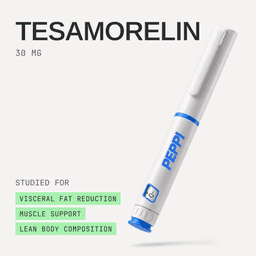
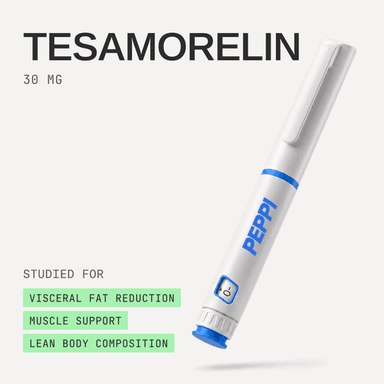
Per the label, tesamorelin raises IGF-1. It can cause glucose intolerance, and its most common side effects include joint pain, swelling, muscle pain and injection site reactions. Peppi's Tesamorelin pen, a compounded pen and not the brand-name drug, holds 30 mg of tesamorelin. Its Tesamorelin benefits & pen page lists visceral fat reduction, muscle support and lean body composition.
CJC 1295 ipamorelin benefits rest on hormone measurements, not muscle measurements. CJC-1295 is a GHRH analog, and ipamorelin binds the same receptor as ghrelin. In two 2006 trials in healthy adults aged 21 to 61, one injection of long-acting CJC-1295 with DAC raised growth hormone 2- to 10-fold for six days or more. Peppi's pen uses CJC-1295 without DAC, so those numbers do not carry over. In a dose-escalation study of eight healthy men per dose, ipamorelin given by IV infusion produced one growth hormone pulse that peaked about 40 minutes after dosing and faded within hours.
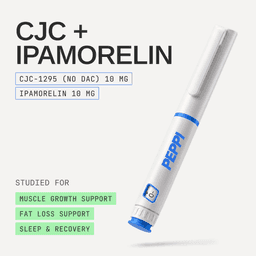
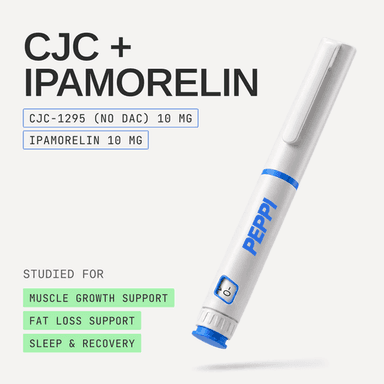
Peppi's CJC + Ipamorelin pen holds 10 mg of CJC-1295 (no DAC) and 10 mg of ipamorelin, listed for muscle growth support, fat loss support, and sleep and recovery. Chris H., a verified buyer, wrote: "The very first thing I noticed with the CJC-1295 and Ipamorelin combo was how much better my workouts were. I started leaning out and retaining muscle much easier without changing my diet. I've been a loyal Peppi customer ever since." That's one person's experience, and results vary.
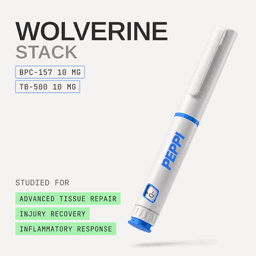
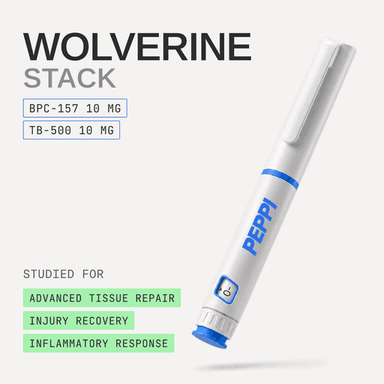
Recovery peptides are a different category. Peppi's Wolverine pen pairs 10 mg of BPC-157 with 10 mg of TB-500, two peptides studied for tissue repair and recovery. Evidence is early: 35 of the 36 sports medicine studies in a 2025 HSS Journal review of BPC-157 were preclinical, and no human trial has tested the pair together.
If you compete in a tested sport, WADA's 2026 Prohibited List bans BPC-157 (section S0), tesamorelin, CJC-1295 and ipamorelin (S2.2.4) and TB-500 (S2.3) at all times.
What Peppi adds is the process around the peptide. Each pen arrives pre-filled with a one-month supply and a twist-to-dose selector, so there is no measuring, mixing or reconstituting. In most cases a licensed clinician reviews your information within 24 hours, decides whether treatment is appropriate and, if so, sets your dose. You can look up Peppi's batch test results by the lot number printed on your pen label.
A Peppi pen adds to the lifting, protein, creatine and sleep habits above, never replaces them, and a clinician licensed in your state decides whether one fits.
Good to knowTesamorelin and CJC + Ipamorelin are never prescribed together. Pricing today: the Tesamorelin pen is $224 for the first month on a subscription, then $359 a month. CJC + Ipamorelin starts at $189, then $303 a month. Peptide therapy is cumulative, and Peppi recommends committing 4 to 6 months. If your prescription isn't approved, you get a 100% refund.
Midlife muscle questions
Three common questions
Not sure where a peptide fits in your plan? Start with Peppi's peptide goal quiz.
Is It Harder to Build Muscle as You Age?
Yes, somewhat, and the gap is manageable. Older muscle responds less to protein. In a 2015 retrospective analysis, healthy men around 71 needed about 0.40 grams of protein per kilogram in a meal to fully stimulate muscle building, against 0.24 for men around 22. In a 2011 meta-analysis of 49 studies, older participants gained a little less lean mass, yet the average across 1,328 adults over 50 was still 1.1 kg.
Can You Still Build Muscle in Your Fifties?
Yes. Everyone in that 1,328-person meta-analysis was 50 or older, and the pooled gain was 1.1 kg of lean body mass. Creatine trials in a 2017 meta-analysis enrolled men and women with average ages of 57 to 70, and creatine plus lifting added 1.37 kg more lean tissue than lifting with a placebo.
What Is Sarcopenia?
Sarcopenia is age-related loss of muscle mass, strength and function. The 2019 European consensus (EWGSOP2) calls it a muscle disease rooted in adverse muscle changes that build up across a lifetime, with low muscle strength as its key sign. Harvard Health cites a 2015 report in which people with sarcopenia had 2.3 times the risk of a low-trauma fracture from a fall. Resistance training and enough protein are the main countermeasures.
These peptides are not FDA-approved and are dispensed only with a prescription.
Peptide guides from Peppi
Keep reading