GHK-Cu vs GLOW at a glance
Same copper, two extras
Both pens carry the same 50 mg of GHK-Cu. GLOW adds 10 mg of BPC-157 and 10 mg of TB-500, so the GHK Cu vs GLOW question is really about whether recovery is part of your goal.
Either way you get a ready-to-use, pre-filled pen, prescribed only after a clinician licensed in your state reviews your intake.
GHK-Cu for skin alone, GLOW when recovery is a goal too
A licensed clinician reviews your intake and decides whether either pen is appropriate for you.
- Both pens hold 50 mg of GHK‑Cu
- GLOW adds 10 mg of BPC‑157 and 10 mg of TB‑500
- Both are third‑party lab tested before they ship
- First month on subscription: $149 for GHK‑Cu, $189 for GLOW
of GHK-Cu in both pens
1 peptide vs 3
No human trial has put GLOW vs GHK Cu to a head-to-head test, so this is a choice about goals. The table shows what differs, from peptides to price.
| Feature | GHK-Cu | GLOW |
|---|---|---|
| Peptides in the pen | GHK‑Cu | BPC‑157, TB‑500 and GHK‑Cu |
| Amount in each pen | 50 mg | 10 mg, 10 mg and 50 mg, 70 mg total |
| Studied for | Skin glow, collagen support and healthy aging | Skin and collagen support, repair and recovery, healthy aging |
| Human research | Limited, and mostly on creams | No published study of the blend |
| First month on subscription | $149 | $189 |
| Renews at | $239 a month | $303 a month |
| One-time purchase | $299 | $379 |
On price, the GLOW peptide vs GHK Cu gap is $40 for the first month on a subscription.
Both pens go through the same checks. Every batch is third-party lab tested for potency, sterility, pH and endotoxicity before it ships. You can look up Peppi's batch test results with the lot number printed on your pen label.
What GHK-Cu peptide does alone
Three amino acids & copper
On its own, GHK-Cu is the skin-focused pen. It holds one naturally occurring copper peptide made of three amino acids, glycine, histidine and lysine, bound to a copper ion.
You will also see it written as GHK Cu peptide or copper tripeptide.
Your body makes it. A 2018 review of copper peptide gene research in the International Journal of Molecular Sciences puts the plasma level at about 200 ng/mL at age 20, declining to 80 ng/mL by age 60.
Gene data are the newer part. Drawing on a public library of gene expression profiles from the Broad Institute, the review reports that GHK changed the activity of 31.2% of human genes by 50% or more. That is lab data from cell lines, not a trial in people. Its authors list a skincare company's research department as their affiliation.
For skin, the same review reports that GHK increases collagen, elastin and glycosaminoglycan synthesis and supports dermal fibroblasts, the cells that build skin's framework. Most of that evidence comes from cell and lab studies.
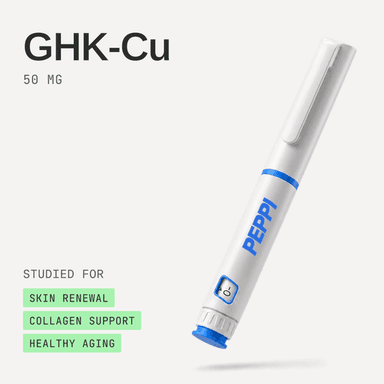
Featured pen
GHK-Cu
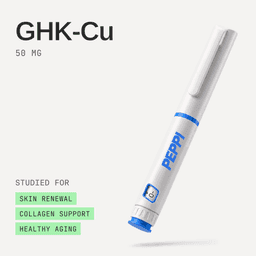
The GHK-Cu pen holds 50 mg of GHK-Cu in one ready-to-use, pre-filled pen. One pen is a one-month supply.
Peppi lists GHK-Cu as studied for skin glow, collagen support and healthy aging. Plans are on the page for Peppi's GHK-Cu pen. It's $149 for the first month on a subscription, then $239 a month.
Sarah T., a verified buyer, wrote: “I originally got GHK-Cu for some lingering skin texture issues. It took a month or two, but my face feels significantly plumper and the fine lines look softer. A surprise bonus was that my hair actually started feeling a lot thicker at the roots, too.” That's one person's experience, and results vary.
What the GLOW peptide blend adds
Two recovery peptides
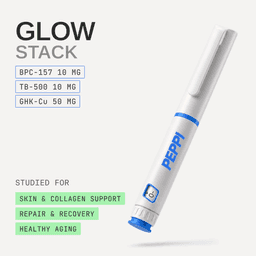
GLOW keeps the same 50 mg of GHK-Cu and adds two peptides studied for recovery: 10 mg of BPC-157 and 10 mg of TB-500. That makes three peptides and 70 mg in one pen.
- GHK-Cu, 50 mg: the same amount as the single pen
- BPC-157, 10 mg: a 15-amino-acid peptide studied mostly in animals and lab models
- TB-500, 10 mg: a lab-made copy of an active region of thymosin beta 4
Each GLOW blend peptide was studied on its own. Peppi says so on the GLOW page: “We found no published study testing the three peptides together.” So the blend is best understood as three separately studied peptides sharing one pen and one prescription.
Peppi lists GLOW in its beauty category, studied for skin and collagen support, repair and recovery, and healthy aging. Plans are on the page for Peppi's GLOW pen. It's $189 for the first month on a subscription, then $303 a month.
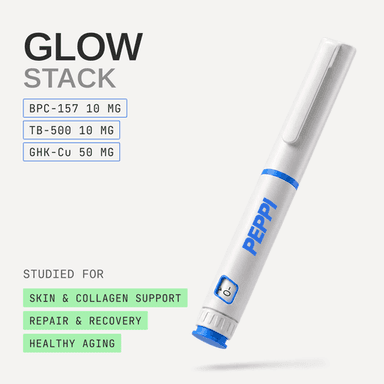
Featured pen
GLOW
GLOW holds 10 mg of BPC-157, 10 mg of TB-500 and 50 mg of GHK-Cu in one ready-to-use, pre-filled pen. One pen is a one-month supply.
Emily C., a verified buyer, described GLOW this way: “I tried Glow to improv my skin, and after a few weeks it definitely looked more hydrated and less wrinkly. I also felt like I bounced back a little better after workouts. I’m a big fan of the product.” Her experience is her own, and results vary.
GHK-Cu benefits vs GLOW benefits
What the evidence covers
Most GHK Cu benefits you'll read about trace back to skin creams, and GLOW peptide benefits add animal and lab research on two recovery peptides. Evidence differs by ingredient, so take them one at a time.
Start with GHK-Cu. The 2018 review cites a result from the proceedings of a 2002 dermatology meeting, not a published trial: in 71 women with mild to advanced photoaging who used a facial cream for 12 weeks, skin density and thickness increased, and laxity, fine lines and wrinkle depth were reduced.
One more detail matters. Those women used a cream, not an injection.
Peppi's GHK-Cu page says as much: “Its research in people is limited and mostly tested creams, not injections.” It also notes that FDA says compounded injectable GHK-Cu may pose a risk of immune reactions.
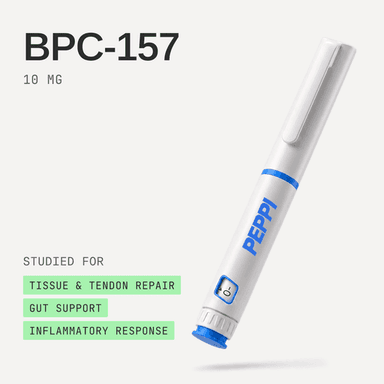
GLOW's added peptides come with a different kind of evidence. A 2025 systematic review in HSS Journal included 36 BPC-157 studies, and 35 of them were preclinical, meaning animal or lab work. In those models, BPC-157 improved functional, structural and biomechanical outcomes in muscle, tendon, ligament and bone injuries. The review found no clinical data on how well BPC-157 is tolerated in people.
TB-500 has less behind it. A 2012 doping-control study in the Journal of Chromatography A identified its key ingredient as a synthetic version of a seven-amino-acid segment of thymosin beta 4. Peppi's GLOW page adds that TB-500 on its own has no published human trials yet.
| Feature | In which pen | Main evidence so far |
|---|---|---|
| GHK-Cu | GHK‑Cu and GLOW | 12‑week cream result, 2002 meeting proceedings |
| BPC-157 | GLOW only | 35 of 36 reviewed studies were preclinical |
| TB-500 | GLOW only | No published human trials yet |
| The three together | GLOW only | No published study of the blend |
Two more facts belong here. Peppi's GHK-Cu, GLOW and KLOW pens are compounded prescription peptides and are not FDA-approved. And the GLOW page states that BPC-157 and TB-500 are prohibited in tested sport. On the 2026 WADA Prohibited List, BPC-157 sits under section S0 and TB-500 under section S2.3.
GHK-Cu dosage vs GLOW dosage
The label vs your dose
There is no established GHK-Cu dosage for injections in people, and the GLOW peptide dosage is no different. What is fixed is the label, and a licensed clinician sets your dose from your intake.
- GHK-Cu pen label: 50 mg of GHK-Cu, a one-month supply
- GLOW pen label: 10 mg of BPC-157, 10 mg of TB-500 and 50 mg of GHK-Cu, a one-month supply
- Your dose: personalized from day one by your clinician
- Taking it: a twist-to-dose selector measures the dose your clinician sets
- Refills: every 28 days, with adjustments through your care team
Peppi's product pages say the same. For the blend: “GLOW has no established human dosage, because no clinical trial has tested the blend.” For the single peptide, the GHK-Cu page says injection frequency “has no standard from clinical research.”
A 2015 review of GHK in BioMed Research International closes on the same gap: “Future research is needed to establish the effective dosage in humans and the best ways of delivery.”
So the amount in the pen is not your dose. Both pens hold 50 mg of GHK-Cu for the month, and your clinician decides how much of it you take and how often. A pre-filled pen means no reconstituting and no mixing, and the twist-to-dose selector does the measuring.
Found a dosing chart for either pen online? Don't use it to set or change a dose. Message your care team first.
Peppi calls peptide therapy cumulative and recommends committing 4 to 6 months for results to build. Response varies from person to person.
Which one fits your goal
Start with your goal
Start with what you want the pen to do. Skin and collagen alone point to GHK-Cu, and skin plus recovery support points to the GLOW stack.
GHK-Cu fits if
- Skin and collagen are your one goal
- You'd like a single peptide in the pen
- A first month at $149 suits your budget
GLOW fits if
- Recovery matters alongside skin
- You want BPC‑157 and TB‑500 in the same pen
- Your clinician agrees a three‑peptide blend suits you
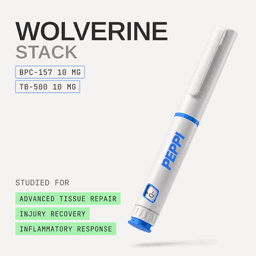
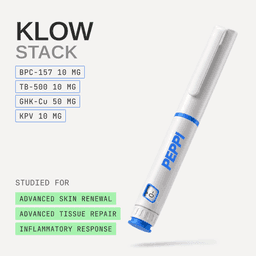
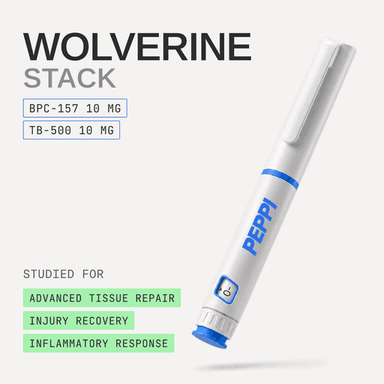
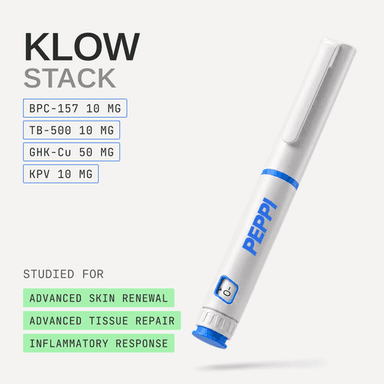
There is a third option. Peppi's KLOW pen holds GLOW's three peptides in the same amounts and adds 10 mg of KPV, which the KLOW page calls an anti-inflammatory tripeptide. It's $224 for the first month on a subscription.
You don't have to settle it alone. A licensed clinician will review your information and determine whether treatment is appropriate for you, and your plan can be adjusted at a 28-day refill.
Not sure if GHK-Cu or GLOW fits your goals?
Take the QuizEither pen starts the same way. You answer an online intake in under 2 minutes, and in most cases a licensed clinician reviews it within 24 hours. A consultation does not guarantee a prescription. If your prescription isn't approved, you get a 100% refund.
Questions about GHK-Cu & GLOW
Frequently asked questions
Short answers on overlap, skin and using both pens.
Does GLOW Contain GHK-Cu?
Yes. GLOW contains 50 mg of GHK-Cu, the same amount as Peppi's single GHK-Cu pen. It also holds 10 mg of BPC-157 and 10 mg of TB-500, for 70 mg in a one-month pen. A clinician licensed in your state reviews your intake and decides which pen, if either, is appropriate for you.
Is GLOW Better Than GHK-Cu for Skin?
No study has compared them, so neither can be called better for skin. Both pens hold the same 50 mg of GHK-Cu, the peptide behind the skin research, which mostly tested creams. GLOW's added peptides, BPC-157 and TB-500, are studied for recovery, mostly in animal and lab work. If skin is your one goal, the GHK-Cu pen is the single-peptide option, at $149 for the first month on subscription.
Can You Take GHK-Cu & GLOW Together?
That is a decision for your prescribing clinician. GLOW already contains the same 50 mg of GHK-Cu as the single pen, so the two pens overlap on their main skin peptide. Neither product page describes using the two together. Your dose is personalized based on your health information, goals and treatment plan, so message your care team before combining pens.
These peptides are not FDA-approved and are dispensed only with a prescription.
Peptide guides from Peppi
Keep reading