GHK-Cu injection vs topical at a glance
On the skin or under it
The GHK Cu injection vs topical choice comes down to route. Serums go on your skin, and an injection goes under it.
Peppi offers the injection route only: GHK-Cu in a ready-to-use, pre-filled pen, prescribed only after a clinician licensed in your state reviews your intake.
A serum is skincare. Peppi's GHK-Cu is a prescription pen with clinician review
A licensed clinician reviews your intake and decides whether a GHK-Cu pen is appropriate for you.
- A serum has to cross your skin's outer layer
- An injection places GHK‑Cu under the skin
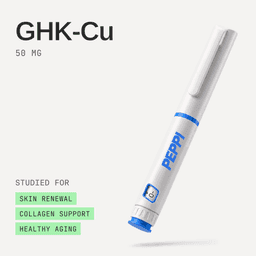
- Peppi's pen holds 50 mg of GHK‑Cu, a one‑month supply
- Every Peppi batch is third‑party lab tested before it ships
of GHK-Cu in Peppi's pen
One-month supply
No trial found for this post has put GHK Cu serum vs injection to a head-to-head test. So the choice is about route, oversight and what the research covered, and the table lays that out.
| Feature | GHK-Cu injection | Copper peptide serum |
|---|---|---|
| What it is | GHK‑Cu in a prescription pen, injected under the skin | A cosmetic with GHK‑Cu that you apply to your skin |
| How you get it | By prescription, after a clinician reviews your intake | Sold as skincare, with no prescription |
| Route | Into the fatty tissue just under the skin | Through the stratum corneum, the skin's outer layer |
| Human skin studies | Limited, and no published trial has timed results | Small studies, two of them from a 2002 dermatology meeting, not published as full trials |
| Who sets the amount | Your clinician, from your intake | The product's own directions |
| What Peppi offers | KLOW, GLOW and GHK‑Cu pens, by prescription | Nothing. Peppi sells no serums or skincare |
Peppi's pen also comes with something you can check. Every batch is third-party lab tested for potency, sterility, pH and endotoxicity before it ships. You can look up Peppi's batch test results with the lot number printed on your pen label.
How topical GHK-Cu works
Through the skin barrier
Topical GHK Cu works from the outside in. You apply a cream or serum, and the peptide has to pass the stratum corneum, your skin's outer layer, to reach the living cells below.
GHK-Cu is a copper peptide made of three amino acids, glycine, histidine and lysine, bound to a copper ion. It occurs naturally in your blood. A 2018 GHK-Cu gene data review in the International Journal of Molecular Sciences puts its plasma level at about 200 ng/mL at age 20 and 80 ng/mL by age 60.
In lab studies, the same review reports, GHK-Cu increases collagen, elastin and glycosaminoglycan synthesis and supports dermal fibroblasts, the cells that build skin's framework.
Its gene data draw on a public library of gene expression profiles from the Broad Institute. There, GHK changed the activity of 31.2% of human genes by 50% or more. That is lab data from cell lines, not a trial in people, and the review's authors list a skincare company's research department as their affiliation.
Getting through the barrier is the hard part for any GHK Cu topical. The 2018 review says GHK-Cu can penetrate the stratum corneum and advises liposomes, tiny fat-based carriers, to increase penetration.
Why the extra help? In 2025, a review in the journal Molecules called GHK-Cu “a fairly hydrophilic compound with limited permeation through the lipophilic stratum corneum.” Put plainly, the peptide mixes with water, and the outer layer of skin is oily.
One lab test measured it. In a 2011 study from the University of California, San Francisco, copper from the tripeptide passed through samples of human skin over 48 hours. That was a water solution on skin samples in a diffusion cell, not a store-bought serum on a face.
Copper peptide serum results
What skin studies found
Copper peptide serum results in people come from a few small studies of creams and one serum-style formula. That is where GHK-Cu's human skin evidence sits.
The 2018 review cites two results from the proceedings of a 2002 dermatology meeting, not published trials. In one, 71 women with mild to advanced signs of photoaging used a GHK-Cu facial cream for 12 weeks. Skin density and thickness increased, and laxity, fine lines and wrinkle depth were reduced.
In the other, 41 women used a GHK-Cu eye cream for 12 weeks, and it performed better than a placebo and a vitamin K cream. The review cites both from meeting proceedings, not journal papers.
One randomized, double-blind trial tested something closer to a serum. As the review describes the 2016 trial, female volunteers applied GHK-Cu in a nano-lipid carrier for 8 weeks. Compared with a control serum, wrinkle volume fell 55.8% and wrinkle depth fell 32.8%.
The review doesn't give that trial's size.
BioImpacts published a 2025 review from a university pharmacy school, whose authors declare no conflict of interest. It looked at GHK-Cu and Pal-GHK, a fat-modified form of GHK. Based on cell studies it called the two “effective and relatively skin permeable,” and it still found “a surprising absence of clinical studies using them.”
So if you're weighing a GHK-Cu face serum, those human results are the ones to judge it by. Peppi doesn't sell one. It offers no serums, creams or other skincare.
How GHK-Cu peptide injection works
Under the skin, by pen
A GHK-Cu peptide injection places the peptide in the fatty tissue just under your skin, so it doesn't have to cross the skin's outer layer first. With Peppi, that injection comes in a ready-to-use, pre-filled pen.
Copper peptide injections are newer to research than creams, and Peppi's GHK-Cu page says so plainly: research in people “is limited and mostly tested creams, not injections.”
In November 2026, a PubMed search for GHK-Cu injection terms, limited to clinical trials, returned no results. Without that limit it returned 18 papers, among them animal studies, reviews and a 2018 pilot of a six-ingredient scalp formula, which can't isolate one peptide.
Cream results don't simply carry over, either. A 2026 review in the journal Life concludes that current evidence “supports product-specific interpretation rather than interchangeability across peptide classes or administration routes.”
Peppi's page also notes that “FDA says compounded injectable GHK-Cu may pose a risk of immune reactions.” Peppi's KLOW, GLOW and GHK-Cu pens are compounded prescription peptides and are not FDA-approved.
What the pen route adds is oversight. A clinician licensed in your state reviews your intake before anything ships, and a licensed U.S. compounding pharmacy fills the prescription. You also get unlimited video calls and messaging with your care team.
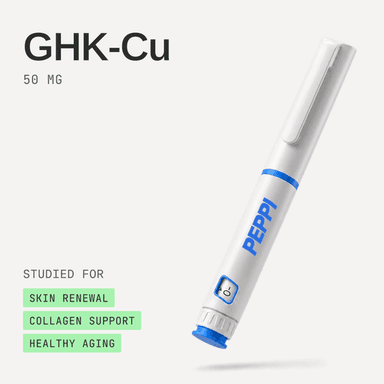
Featured pen
GHK-Cu
The GHK-Cu pen holds 50 mg of GHK-Cu in one ready-to-use, pre-filled pen. One pen is a one-month supply.
Plans are on the page for the GHK-Cu peptide injection pen. It's $299 one-time, or $149 for the first month by subscription, then $239 a month. Peppi lists it as studied for skin glow, collagen support and healthy aging.
GHK-Cu injection dosage
Your clinician sets it
Clinical research has not established a GHK-Cu peptide injection dosage. What is fixed is the label on the pen, and a licensed clinician sets your dose from your intake.
- Pen label: 50 mg of GHK-Cu, a one-month supply
- Your dose: personalized from day one by your clinician
- Taking it: a twist-to-dose selector measures the dose your clinician sets
- Refills: every 28 days, with adjustments through your care team
Peppi's GHK-Cu page says injection frequency “has no standard from clinical research.” A 2026 narrative review in the American Journal of Sports Medicine covered GHK-Cu among other injectable peptides. Its conclusion: “information regarding the indications, dosing, frequency, and duration of treatment remains unknown.”
So the 50 mg in the pen is not your dose. Your clinician decides how much you take and how often. Because the pen arrives pre-filled, there is no reconstituting, no mixing and no measuring doses from a vial.
Found a GHK-Cu dosing chart online? Don't use it to set or change a dose. Message your care team first.
Which GHK-Cu form fits your goal
Match the form to the goal
Start with what you want and how you'd like to get there. The GHK Cu benefits Peppi lists for its pen are skin glow, collagen support and healthy aging, and the pen is the form that comes with a clinician, a pharmacy fill and a lot report.
A GHK-Cu pen may fit if
- Skin glow and collagen support are your goals
- You want a prescription a licensed clinician reviews
- You'd like a lot number you can look up
- You can commit 4 to 6 months, as Peppi recommends
A serum may fit if
- You want skincare with no prescription
- You'd rather not use an injection
- You want a cosmetic step in your skincare routine
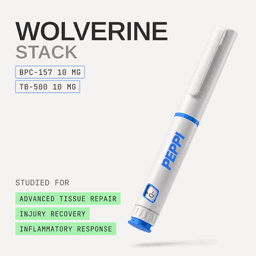
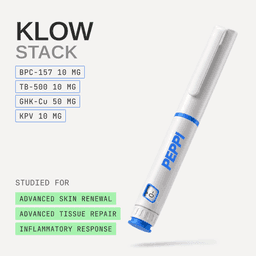
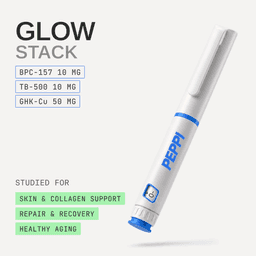
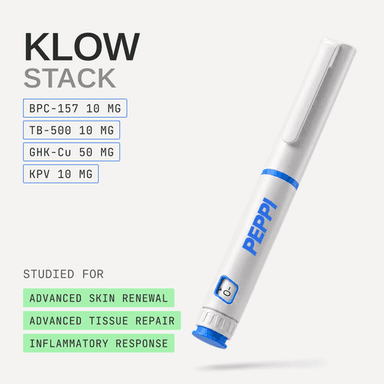
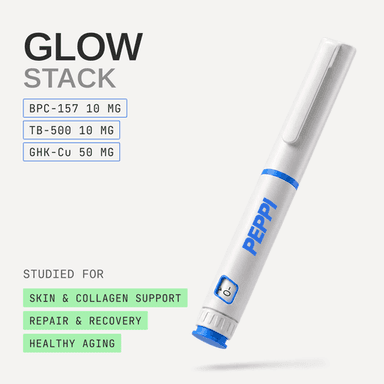
Peppi offers GHK-Cu in two blends as well. Peppi's GLOW pen holds 50 mg of GHK-Cu with 10 mg each of BPC-157 and TB-500. Peppi's KLOW pen adds 10 mg of KPV to those three.
Peppi's product pages say Peppi found no published study testing GLOW's three peptides together, and that the KLOW blend has not been studied in people, so a clinician weighs your goals before prescribing either.
You don't have to treat the two forms as rivals. No published study tests a serum alongside injections, based on a November 2026 PubMed search, so tell your clinician what you use on your skin.
Not sure which Peppi pen fits your skin goals?
Take the QuizStarting takes under 2 minutes online, and in most cases a licensed clinician reviews your intake within 24 hours. A consultation does not guarantee a prescription. If your prescription isn't approved, you get a 100% refund.
Questions about GHK-Cu forms
Frequently asked questions
Short answers on comparing, combining and timing.
Is Injectable GHK-Cu Better Than Topical?
No study has compared the two routes, so neither can be called better. GHK-Cu's human skin results come from small studies of creams and one serum-style formula, two of them presented at a 2002 dermatology meeting, not published as full trials. An injection places a clinician-set amount under the skin, and human data on that route are limited. A licensed clinician determines whether a pen is appropriate for you.
Can You Use a Copper Peptide Serum With GHK-Cu Injections?
No study found for this post tests the two together, so there is no evidence-based rule in either direction. A PubMed search in November 2026 for GHK-Cu topical and injection terms returned one paper, a hair clinic's report on a multi-drug combination that can't isolate GHK-Cu. Peppi's GHK-Cu comes as a prescription pen, not a serum, so tell your clinician what you use on your skin.
How Long Does GHK-Cu Take to Work?
It depends on the form. The cream and serum-style studies described in a 2018 review measured skin changes at 8 and 12 weeks, and two of them come from 2002 meeting proceedings, not published trials. For injections, Peppi's GHK-Cu page says no published trial has timed results. Peppi calls peptide therapy cumulative and recommends committing 4 to 6 months, and response varies from person to person.
These peptides are not FDA-approved and are dispensed only with a prescription.
Peptide guides from Peppi
Keep reading