
How peptides calm inflammation
Signals, studied in the lab
This list of the best peptides for inflammation covers BPC-157, KPV, TB-500, GHK-Cu and KLOW, the Peppi blend that carries all four. Each is here because cell or animal studies of it, or of its parent molecule, measured a drop in an inflammatory signal. None has a published trial in people showing it lowers inflammation.
Inflammation itself is not the enemy.
The National Institute of Environmental Health Sciences calls it a normal part of the body's defense to injury or infection, and says it becomes damaging when it occurs in healthy tissues or lasts too long. Research on peptides for inflammation looks at the signals behind that response. Lab teams stimulate cells or animals, add a peptide, then measure messengers such as NF-kappaB, TNF-alpha and IL-6. A lower reading in a dish or a mouse is a lead for further study. It is not a result in a person.
Quality is the part you can check yourself. Independent labs test every Peppi batch for potency, sterility, pH and endotoxicity before it ships, and you can look up Peppi's batch test results by the lot number printed on your pen label.
The short answer
KPV's research is about inflammation first, in human cell lines and in mice. BPC-157's comes from rat models, TB-500's from cell work on its parent peptide, and GHK-Cu's from human skin cells in a dish. KLOW puts all four in one ready-to-use, pre-filled pen, though the blend itself has not been tested in people. A licensed clinician reviews your intake before anything ships.
- Number 1.
BPC-157 for inflammation & the gut
The gastric peptide
$149
$299first monthStudied forTissue & tendon repair, gut support & anti‑inflammatory
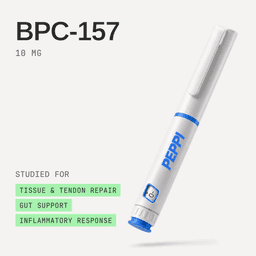
In the pen10 mg BPC‑157
Inflammation evidenceRat models
Price$149 first month, then $239 a month
BPC-157 starts this list because its story begins in the gut. Peppi's product page describes it as a 15-amino-acid peptide, first described in 1993 and isolated as part of a larger compound found in human gastric juice.
Most BPC 157 benefits you'll read about trace back to animal work. A 2025 systematic review in HSS Journal included 36 studies, 35 of them preclinical. Its authors report that the studies suggest BPC-157 reduces inflammatory cytokines, and they found no clinical data on how well it is tolerated.
On the gut side, a 2013 rat study in the Journal of Physiology and Pharmacology induced colitis with a chemical called cysteamine. Untreated rats did not recover during the study. Rats given BPC-157, by injection or in drinking water, did.
That is a rat model, from the University of Zagreb group that first described the peptide.
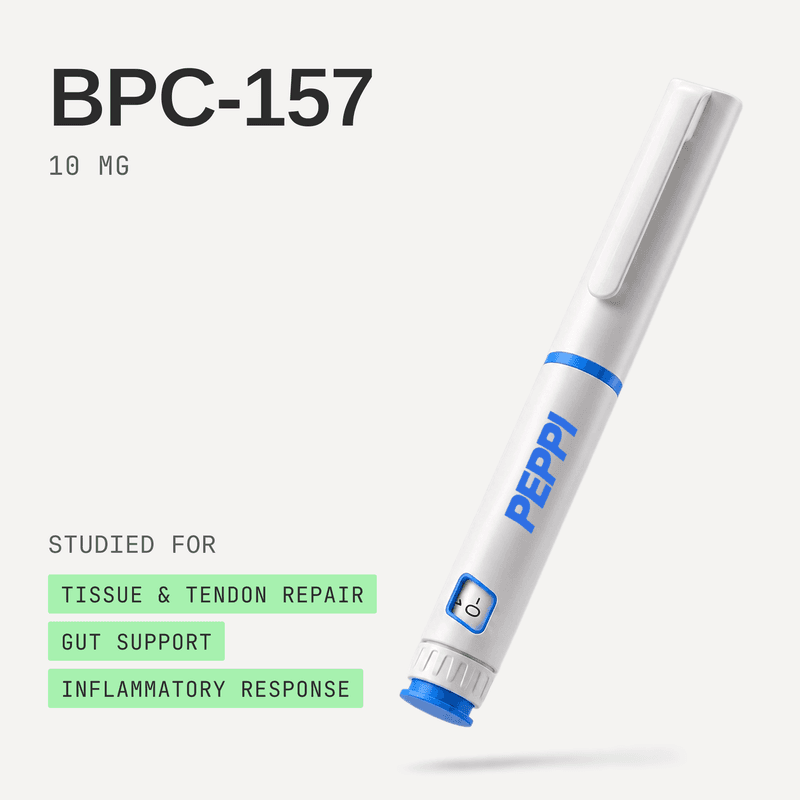
Peppi's BPC-157 peptide pen holds 10 mg as a one-month supply, and Peppi lists it as studied for tissue and tendon repair, gut support and anti-inflammatory. The same page notes that the BPC-157 peptide "has limited research in people" and that "its exact mechanism and molecular targets haven't been confirmed." A licensed clinician reviews your intake and determines whether it's appropriate for you.
- A single peptide in one pen
- Gut & inflammation data: rats so far
- Your clinician sets the dose
- Number 2.
KPV peptide benefits for inflammation
Three amino acids from alpha-MSH
Studied forInflammatory signaling, in cells & mice
In Peppi's pens10 mg in KLOW
Inflammation evidenceHuman cell lines & mouse models
KPV is the peptide on this list whose research is about inflammation first. If you're asking what does KPV peptide do, the lab answer is that it quieted inflammatory signaling in human cell lines and in mice.
It is three amino acids long: lysine, proline and valine, the tail end of the hormone alpha-MSH. A 2008 review in Endocrine Reviews explains the interest. Alpha-MSH has anti-inflammatory effects but also acts on skin pigment, and KPV, its authors note, kept the first without the second in lab and animal work.
KPV peptide benefits in the research come from two kinds of study. In a 2008 Gastroenterology paper, KPV inhibited NF-kappaB and MAP kinase signaling in human intestinal and immune cell lines. Added to the drinking water of mice with chemically induced colitis, it lowered the expression of pro-inflammatory signaling molecules. A second 2008 study, in Inflammatory Bowel Diseases, reported earlier recovery and fewer inflammatory cells in the colon tissue of treated mice. A 2016 KPV colitis study in mice used a model of colitis-linked colon tumors, and KPV-treated animals again showed less inflammation in the colon.
Every one of those results is preclinical.
Peppi's KLOW page says so directly: KPV has "no published human trials yet." Peppi does not sell KPV alone. It comes at 10 mg inside the KLOW pen.
- Tested in human cell lines & in mice
- No published human trials yet
- At Peppi, only inside KLOW
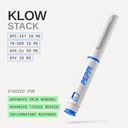 TryKLOW Stack$224
- Number 3.
TB-500 & the inflammatory response
A fragment of thymosin beta-4
Studied forNF‑kappaB activity in cells, as thymosin beta‑4
In Peppi's pens10 mg in Wolverine, KLOW & GLOW
Inflammation evidenceCell work on the parent peptide
TB-500's link to inflammation runs through its parent molecule, thymosin beta-4. A 2012 doping-control paper in the Journal of Chromatography A describes TB-500 as a synthetic version of a seven-amino-acid segment of that protein, the active site tied to actin binding, cell migration and wound healing.
The inflammation data belongs to the full 43-amino-acid parent. In a 2007 study in Experimental Eye Research, human corneal cells were stimulated with TNF-alpha, a pro-inflammatory messenger. Cells that also received thymosin beta-4 showed lower NF-kappaB activity than cells that did not.
So most TB 500 benefits for inflammation are borrowed from thymosin beta-4. A PubMed search in November 2026 returned four papers on TB-500 and inflammation: a doping-control analysis, an orthopedics review, a policy analysis and a narrative review with three case reports. Peppi's Wolverine page notes that TB-500 on its own has no published human trials yet.
Peppi doesn't sell TB-500 alone.
Each Wolverine, KLOW and GLOW pen holds 10 mg of it, always alongside BPC-157, and Peppi lists the Wolverine stack as studied for anti-inflammatory, injury recovery and advanced tissue repair.
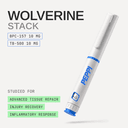 TryWolverine Stack$189
- Number 4.
GHK-Cu for skin inflammation
A copper peptide for skin
$149
$299first monthStudied forSkin glow, collagen support & healthy aging
In the pen50 mg GHK‑Cu
Inflammation evidenceHuman skin cells in a dish
Price$149 first month, then $239 a month
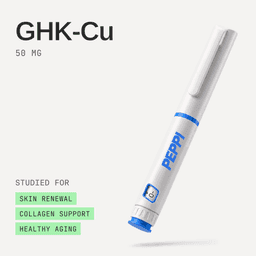
GHK-Cu is the skin entry. Peppi's product page calls it a small, naturally occurring tripeptide in human plasma that is also released from tissue after an injury, and Peppi lists it as studied for skin glow, collagen support and healthy aging.
Its inflammation research is one step back from skin itself. In a 2012 cell study in Acta Poloniae Pharmaceutica, researchers exposed normal human skin fibroblasts to TNF-alpha, which prompts them to release IL-6, a pro-inflammatory messenger. GHK and its copper complex both decreased that IL-6 release. The same paper is frank about the gap: "The mechanism of anti-inflammatory properties of these peptides is not clear."
Read GHK Cu benefits for inflammation at that level: a signal in skin cells in a dish, not a measured change in anyone's skin.
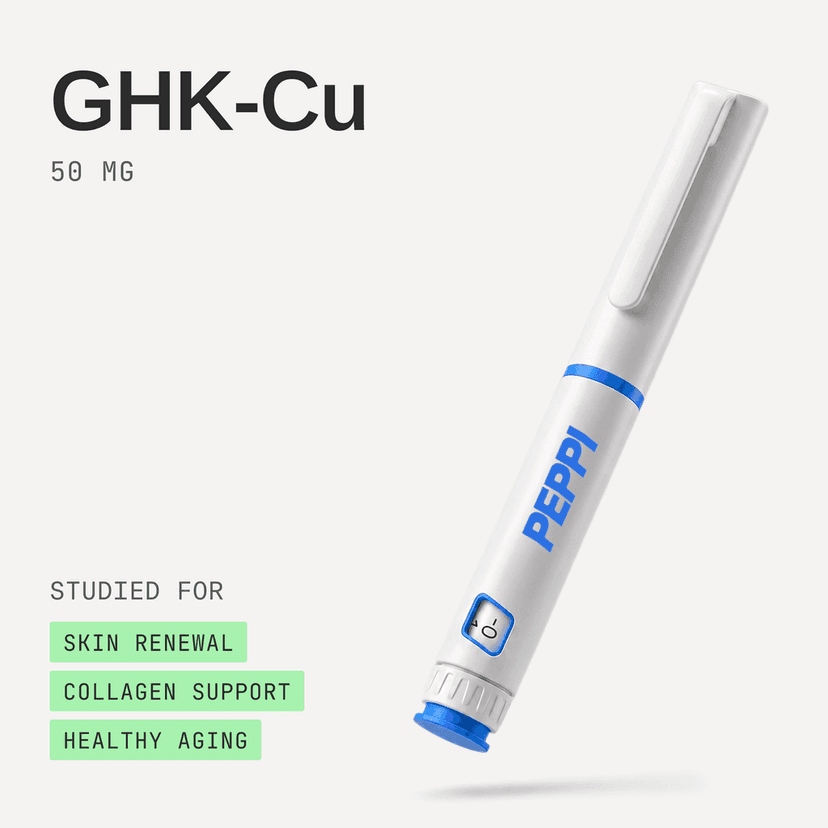
Peppi's GHK-Cu pen holds 50 mg as a one-month supply. Peppi's page notes that research in people "is limited and mostly tested creams, not injections," and that "FDA says compounded injectable GHK-Cu may pose a risk of immune reactions." That second line is one to raise with your care team.
- A copper tripeptide found in human plasma
- Inflammation data: skin cells in a dish
- A clinician reviews every order
- Number 5.
KLOW for whole-body inflammation
All four peptides in one pen
$224
$449first monthStudied forAdvanced skin glow, advanced tissue repair & anti‑inflammatory
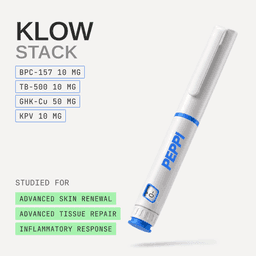
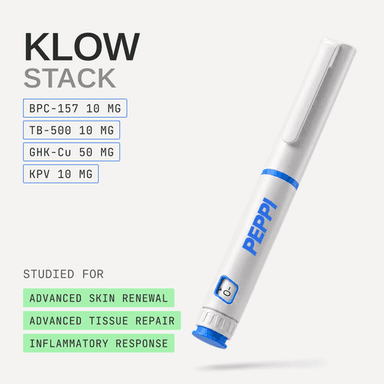
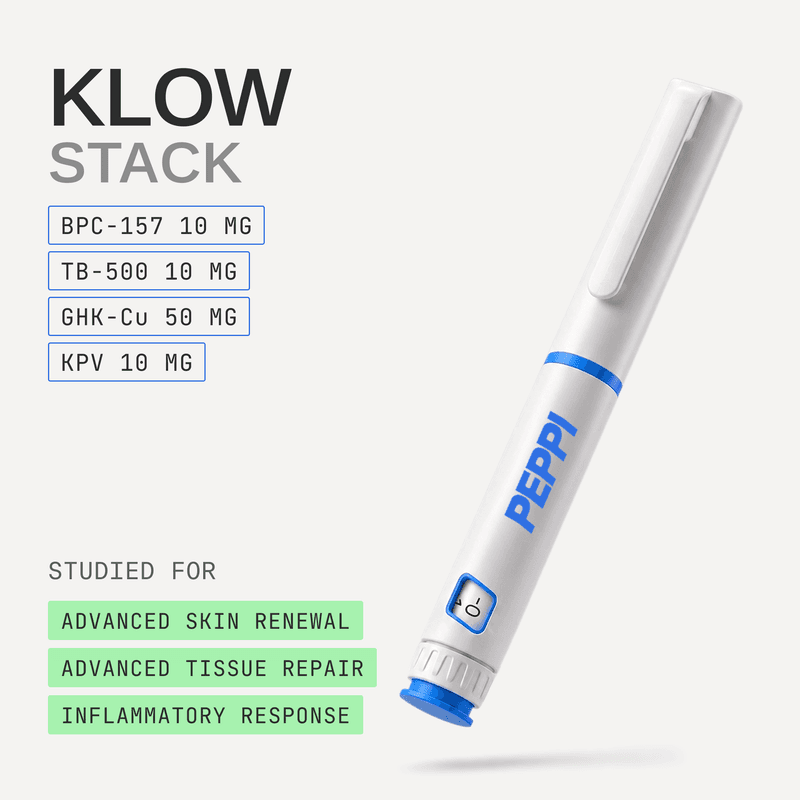
In the penBPC‑157 10 mg, TB‑500 10 mg, GHK‑Cu 50 mg, KPV 10 mg
Inflammation evidenceFrom its parts, not the blend
Price$224 first month, then $359 a month
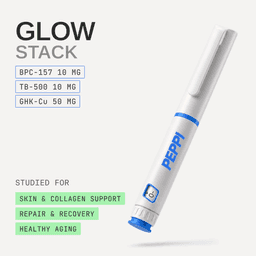
KLOW closes the list because it holds every peptide above. For anyone asking what is KLOW peptide, Peppi's product page answers in one line: "KLOW builds on GLOW (BPC-157, TB-500, GHK-Cu) and adds KPV, an anti-inflammatory tripeptide." That makes Peppi's KLOW pen the only Peppi pen with KPV. It carries 10 mg of KPV, 10 mg each of BPC-157 and TB-500, and 50 mg of GHK-Cu as a one-month supply.
Read KLOW peptide benefits as the sum of separately studied parts. The gut, cell and skin findings in the four entries above each belong to one peptide. Peppi states that no trial has tested the KLOW blend itself in people, so "whole-body" describes the range of the research behind its parts, not a measured effect of the pen.
What the blend changes is practical. You get four peptides in one pen with a twist-to-dose selector and nothing to mix or measure, and the dose is the one your clinician sets from your intake.
- The only Peppi pen with KPV
- Four peptides, one twist‑to‑dose pen
- Blend not yet tested in people
Pairing peptides for healing
One pen or a blend
Pairing is where most reading about peptides for healing ends up, so it helps to know which Peppi pens combine peptides. Three of its pens carry the anti-inflammatory tag, and two of those are blends.
| Feature | In the pen | Peppi lists it as studied for |
|---|---|---|
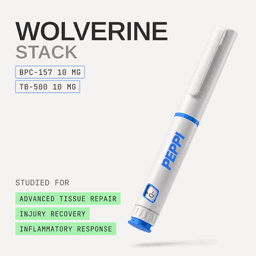
| Wolverine | BPC‑157 10 mg, TB‑500 10 mg | Anti‑inflammatory, injury recovery, advanced tissue repair |
| KLOW | BPC‑157 10 mg, TB‑500 10 mg, GHK‑Cu 50 mg, KPV 10 mg | Anti‑inflammatory, advanced tissue repair, advanced skin glow |
| BPC-157 | BPC‑157 10 mg | Anti‑inflammatory, tissue & tendon repair, gut support |
| GHK-Cu | GHK‑Cu 50 mg | Skin glow, collagen support, healthy aging |
Research on pairs is thinner than research on single peptides. Peppi's Wolverine page states that no human trial has tested BPC-157 and TB-500 together. In a 2026 exploratory study of 32 rats with a repaired Achilles tendon, both peptides were associated with better tissue scores at four weeks, and the pair did not add to either one alone. That is one tendon model in rats, not an inflammation study, and its authors call for longer ones.
So the choice between a single pen and a blend comes down to your goals, which is what the intake asks about.
Each pen is the right fit for someone.
Peppi's Wolverine, KLOW, BPC-157, GLOW and GHK-Cu pens are compounded prescription peptides, filled by a licensed U.S. pharmacy after clinician review, and are not FDA-approved. A licensed clinician reviews your intake and determines whether one is appropriate for you.
Not sure which recovery pen fits your goals?
Take the QuizGetting started takes under 2 minutes online. A clinician licensed in your state reviews your intake, in most cases within 24 hours, and a licensed U.S. pharmacy fills the prescription. If your prescription isn't approved, you get a 100% refund. Peppi notes that peptide therapy is cumulative and recommends 4 to 6 months for results to build.
Featured pen
Wolverine
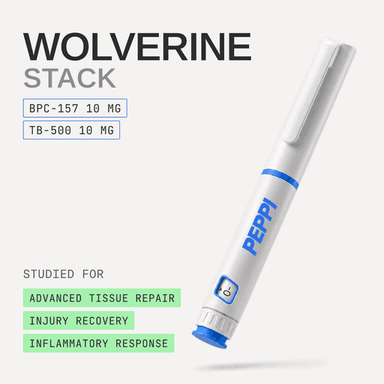
BPC-157 and TB-500, 10 mg each, in one ready-to-use, pre-filled pen. A clinician licensed in your state reviews your intake before anything ships.
Questions about peptides for inflammation
Frequently asked questions
What Is the Strongest Anti-Inflammatory Peptide?
No study cited here ranks them, so none can be called the strongest. Each peptide was tested in a different model: KPV in human cell lines and mice with chemically induced colitis, BPC-157 in rats, TB-500's parent peptide thymosin beta-4 in corneal cells and GHK in skin cells. Different models can't be compared with each other. Peppi's KLOW pen carries all four, and a licensed clinician determines whether it's appropriate for you.
Is KPV or BPC-157 Better for Inflammation?
No published study has compared them head to head. A PubMed search in November 2026 returned one paper naming both, a policy analysis and not a comparison. KPV's research centers on inflammatory signaling in cells and mice, while BPC-157's is mostly tissue repair in animals. At Peppi, the KLOW pen holds 10 mg of each, and a licensed clinician determines whether it's appropriate for you.
Can Peptides Replace Anti-Inflammatory Drugs?
No. None of the studies cited here compared a peptide with an anti-inflammatory drug in people, and Peppi's product pages state that its peptides are not approved to treat any condition. If your doctor has prescribed a medication for an inflammatory condition, keep taking it as directed, and talk to that doctor before changing anything.
These peptides are not FDA-approved and are dispensed only with a prescription.
Peptide guides from Peppi
Keep reading