The Wolverine stack is a pairing of two recovery peptides, BPC‑157 and TB‑500. Peppi offers it as a ready‑to‑use, pre‑filled pen that ships only after a clinician licensed in your state reviews your intake.
This guide covers what each peptide is, what its research shows and in whom, how dosing works with a pen, and how Wolverine differs from KLOW. Evidence levels are named as they come up, because the two peptides have different research behind them.
The short answer
Wolverine combines BPC-157 10 mg and TB-500 10 mg in one pen. Peppi's Wolverine page lists three studied-for tags: Advanced Tissue Repair, Injury Recovery and Anti-inflammatory. The research on each peptide is mostly in animals, and no human trial has tested the two together, so a licensed clinician weighs your goals and sets your dose.
- BPC‑157 10 mg & TB‑500 10 mg
- Third‑party tested, batch by batch
- A licensed clinician sets your dose
- Pre‑filled pen, nothing to mix or measure
Chapter 01 of 07
What the Wolverine stack is
Two peptides, one pen
What is the Wolverine stack? Two recovery peptides in one prescription pen. Peppi's Wolverine stack pen holds BPC‑157 10 mg and TB‑500 10 mg, 20 mg in total, as a one‑month supply.
On its Wolverine page, Peppi defines it this way: "The Wolverine Stack is a pairing of two peptides studied for tissue repair: BPC‑157 and TB‑500."
You'll also see it called the Wolverine peptide, though the name covers two peptides, not one.
The pen is the other half of the offer. It arrives pre‑filled with a one‑month supply, so there is no reconstituting and no mixing. A twist‑to‑dose selector handles dosing, and there is a fresh needle for every dose.
Peppi's Wolverine, KLOW and BPC‑157 pens are compounded prescription peptides and are not FDA‑approved. A licensed U.S. compounding pharmacy fills each prescription.
Key takeawayOne prescription pen, two recovery peptides: BPC‑157 10 mg and TB‑500 10 mg.
Chapter 02 of 07
BPC-157 in the Wolverine stack
A 15-amino-acid peptide
BPC‑157 is the first half of the Wolverine stack. Peppi's BPC‑157 page describes it as "a lab‑made peptide of 15 amino acids, based on a fragment of a protein first isolated from human gastric juice."
Most research behind BPC 157 and TB 500 comes from animals, as Peppi's Wolverine page notes. For BPC‑157, a 2025 systematic review in HSS Journal lays out the record. Its authors identified 544 articles and included 36 studies. Thirty‑five were preclinical, meaning animal or lab work.
In those preclinical models, BPC‑157 improved functional, structural and biomechanical outcomes in muscle, tendon, ligament and bone injuries.
The one clinical study was a retrospective report. In it, 7 of 12 people with chronic knee pain reported relief for more than six months after an injection into the knee. In studies published through June 2024, the reviewers found no clinical data on how well BPC‑157 is tolerated in people.
With research this early, a clinician weighs your goals and history before prescribing.
Prefer one peptide to a BPC 157 TB 500 blend? Peppi's BPC-157 pen holds 10 mg of BPC‑157 on its own, with the same clinician review and twist‑to‑dose selector.
Key takeawayBPC‑157 is the 15‑amino‑acid half of Wolverine, covered by 36 studies in a 2025 review.
Chapter 03 of 07
TB-500 peptide in the Wolverine stack
A thymosin beta-4 fragment
TB‑500 is the second half of the stack. The TB 500 peptide is a lab‑made copy of a seven‑amino‑acid stretch of thymosin beta‑4, a protein of 43 amino acids.
A 2012 doping‑control paper in the Journal of Chromatography A gives the detail. It describes TB‑500 as a veterinary preparation whose key ingredient is that seven‑amino‑acid segment. The paper calls the segment the active site within thymosin beta‑4 for actin binding, cell migration and wound healing. Its subject was detecting TB‑500 in horses, not testing benefits.
The parent protein has its own research. A 2007 review in Clinical Ophthalmology summarizes one corneal wound healing study after another, in cells, rats and mice.
In mice with alkali burns to the eye, 70% of untreated eyes had bleeding inside the eye and a fully clouded cornea, compared with 20% of eyes given thymosin beta‑4. Writing in 2007, the authors said well‑controlled clinical trials were being planned.
Those experiments used the full protein in the eye, not the TB‑500 fragment. On the fragment, Peppi's Wolverine page is direct: "FDA has identified no human exposure data for TB‑500."
Peppi does not offer TB‑500 as a single‑peptide pen. It comes only inside a blend, and only by prescription.
Key takeawayTB‑500 is a lab‑made copy of a seven‑amino‑acid stretch of thymosin beta‑4.
Chapter 04 of 07
Wolverine stack benefits
Studied for three goals
Wolverine stack benefits are best read as two research trails, one per peptide. Peppi lists the pen with three studied‑for tags: Advanced Tissue Repair, Injury Recovery and Anti‑inflammatory.
Read any list of Wolverine peptide benefits with one line from Peppi's own benefits section in mind: "Studied for, not promised. Your clinician helps you decide what's right for you."
The pairing has a direct test in animals. A 2026 rat study in Joint Diseases and Related Surgery assigned 32 rats to BPC‑157, TB‑500, both or neither for four weeks after Achilles tendon surgery.
Both peptides were associated with better tendon structure under the microscope, though BPC‑157's total scores did not reach statistical significance. The TB‑500 group alone reached a significantly higher maximum load, a measure of tendon strength. The combination did not add to either peptide alone, and the authors called the work exploratory and asked for longer studies.
In people, Peppi's Wolverine page says it plainly: "No human trial has tested BPC‑157 and TB‑500 together." That is where a clinician comes in, weighing your goals and history before prescribing.
One note for athletes. The 2026 WADA Prohibited List names BPC‑157 under section S0 and TB‑500 under section S2.3, and both sections are prohibited at all times.
| Detail | Studied in | What was reported |
|---|---|---|
| BPC-157 | 36 studies in a 2025 review, 35 preclinical | Better outcomes in animal injury models |
| Thymosin beta-4, TB-500's parent | Cells, rats & mice in a 2007 review | Severe damage in 20% of treated mouse eyes vs 70% untreated |
| BPC-157 with TB-500 | 32 rats in a 2026 study | Better tendon structure, no added effect as a pair |
| Wolverine in people | No human trial of the pair | A clinician weighs your goals |
Key takeawayRead Wolverine as two research trails: one for BPC‑157, one for TB‑500's parent protein.
Chapter 05 of 07
Wolverine stack dosage
Set by your clinician
There is no established Wolverine stack dosage. Peppi's Wolverine page gives the reason: "no human trial has tested BPC‑157 and TB‑500 together."
What is fixed is the pen: BPC‑157 10 mg and TB‑500 10 mg, pre‑mixed as a one‑month supply.
Your dose is another matter. In the words of Peppi's FAQ page, "Your dose is personalized based on your health information, goals, and treatment plan." A clinician licensed in your state sets it from your intake, and the twist‑to‑dose selector delivers it.
A Wolverine peptide dosing chart only matters if you measure doses yourself. With a pre‑filled pen, you don't. Peppi's FAQ page describes what the pen replaces: "there's no need to mix powders, reconstitute medication, or measure doses from a vial."
Independent labs test every Wolverine batch for potency, sterility, pH and endotoxicity before it ships. Your lot number is printed on the pen label, and you can match it against Peppi's batch test results.
Good to knowFound a Wolverine chart online? Your dose still comes from your clinician, so bring questions to your care team.
Key takeawayNo chart needed: your clinician sets the dose and the pen's selector delivers it.
Chapter 06 of 07
Wolverine stack before & after
Results build over months
For a Wolverine stack before and after, Peppi points to months, not days. It calls peptide therapy cumulative and recommends that patients commit 4 to 6 months for results to build.
That is Peppi's guidance. No trial in people has measured the pairing before and after, and response varies from person to person.
Jason B., a verified buyer, described his experience with Wolverine this way: "I started Wolverine because I had a few nagging things that just weren't getting better. It wasn't some overnight change, but after a few weeks I felt less beat up and could train more consistently again. The pen was also way easier than I expected." That's one person's experience, not a typical result, and results vary.
What Peppi does publish is the process. The online intake takes under 2 minutes. In most cases, a licensed clinician reviews your information within 24 hours, and an approved order typically arrives within 2 to 3 days.
Each pen is refilled every 28 days. In between, you have unlimited video calls and messaging with your care team, the place to raise how things are going. You can pause or cancel anytime.
Key takeawayPeppi recommends 4 to 6 months, with a care team to check in with along the way.
Chapter 07 of 07
Wolverine stack vs KLOW
Same base, two more peptides
Wolverine and KLOW share a base. Peppi's KLOW pen holds the same BPC‑157 10 mg and TB‑500 10 mg, then adds GHK‑Cu 50 mg and KPV 10 mg, for 80 mg in total.
So the KLOW vs Wolverine choice turns on your goals. Peppi lists both pens under Recovery. Wolverine's tags are Advanced Tissue Repair, Injury Recovery and Anti‑inflammatory. KLOW's are Advanced Skin Glow, Advanced Tissue Repair and Anti‑inflammatory.
There is no head‑to‑head result to lean on. Peppi's pages say that no human trial has tested BPC‑157 and TB‑500 together and that no trial has tested the KLOW blend in people.
Each pen is the right choice for someone, and a licensed clinician determines which is appropriate for you.
Getting started is one short intake. If your prescription isn't approved, you get a 100% refund.
| Detail | Wolverine | KLOW |
|---|---|---|
| Peptides | BPC‑157 & TB‑500 | BPC‑157, TB‑500, GHK‑Cu & KPV |
| Total in the pen | 20 mg | 80 mg |
| Added to the base | Nothing | GHK‑Cu 50 mg & KPV 10 mg |
| Shop category | Recovery | Recovery |
| One-time purchase | $379 | $449 |
| By subscription | 50% off month one | 50% off month one |
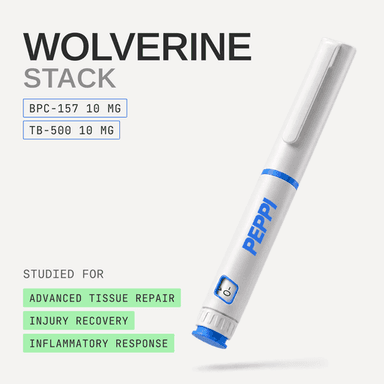
Featured pen
Wolverine
BPC-157 10 mg and TB-500 10 mg in one ready-to-use, pre-filled pen. A clinician licensed in your state reviews your intake before anything ships.
Not sure whether Wolverine or KLOW fits your goals?
Take the QuizKey takeawayWolverine is the two‑peptide recovery pen. KLOW adds GHK‑Cu and KPV, and your goals decide.
Questions about the Wolverine stack
Frequently asked questions
What Is the Wolverine Stack Used For?
The Wolverine stack is a prescription pairing of two peptides, BPC-157 and TB-500. Peppi's Wolverine page lists three studied-for tags: advanced tissue repair, injury recovery and anti-inflammatory. The research on both peptides is mostly in animals, and Wolverine is not approved to treat any condition. A licensed clinician determines whether it is appropriate for you.
How Long Should You Run the Wolverine Stack?
No clinical trial sets a length for the Wolverine stack, so the answer comes from your clinician. Peppi calls peptide therapy cumulative and recommends committing 4 to 6 months for results to build. Each pen is a one-month supply, refilled every 28 days, and you can pause or cancel anytime. Your care team can adjust your plan along the way.
Does the Wolverine Stack Work for Old Injuries?
A licensed clinician reviews your health history and determines whether the Wolverine stack is appropriate for you. No human trial has tested the pairing for any injury, old or new. A 2026 rat study of the pairing looked at tendons in the first four weeks after surgery. Wolverine is not approved to treat any condition.
These peptides are not FDA-approved and are dispensed only with a prescription.
Peptide guides from Peppi
Keep reading