Four peptides go into Peppi's KLOW pen, and KPV is the one KLOW adds to GLOW's three. It is three amino acids long, and its research so far sits in cell cultures and mice.
Below is what the gut and skin studies found, how dosing works when no chart applies, and how KPV compares with BPC‑157. Peppi offers KPV only inside KLOW, a ready‑to‑use, pre‑filled pen prescribed by a licensed clinician.
The short answer
KPV is a tripeptide taken from the hormone alpha-MSH. In human cell lines and in mice with chemically induced colitis, it lowered inflammatory signaling. Peppi's KLOW page notes that KPV has no published human trials yet. Peppi offers it only in the KLOW pen, where a licensed clinician sets your dose.
- KPV: lysine, proline & valine, from alpha‑MSH
- Research so far: human cell lines & mice
- A licensed clinician sets your KLOW dose
- At Peppi, KPV comes only in the KLOW pen
Chapter 01 of 07
KPV peptide benefits in the research
Cells & mice, so far
KPV peptide benefits, as the research stands, come down to one finding: quieter inflammatory signaling in lab models. Every KPV study cited here used cell cultures or mice.
A 2008 review in Endocrine Reviews sets out the background. Its authors explain that alpha‑MSH, a hormone your body makes, has anti‑inflammatory effects but also affects skin pigment. KPV, the last three amino acids of that hormone, kept the anti‑inflammatory effect without the pigment effect. That made it a candidate for further study.
On the limit of KPV benefits, Peppi's KLOW page is plain: KPV has "no published human trials yet."
| Detail | Tested in | What was reported |
|---|---|---|
| Cell & mouse study, 2008 | Human cell lines & mice with colitis | Less inflammatory signaling |
| Mouse study, 2008 | Two mouse models of colitis | Earlier recovery & fewer inflammatory cells |
| Review, 2008 | Lab & animal work on alpha‑MSH | Anti‑inflammatory with no pigment effect |
| Human trials | None published yet | Still to be studied in people |
Key takeawayKPV's research points to an anti‑inflammatory signal, studied so far in cells and mice.
Chapter 02 of 07
What KPV peptide is
The tail end of alpha-MSH
The short answer to what is KPV peptide: a chain of three amino acids, lysine, proline and valine, named for their one‑letter codes K, P and V. It is the tail end of alpha‑melanocyte‑stimulating hormone, or alpha‑MSH.
Alpha‑MSH is 13 amino acids long and also acts on pigment cells. A 2007 paper in Annals of the Rheumatic Diseases, by two of the Endocrine Reviews authors, states that most of the hormone's anti‑inflammatory activity can be attributed to that three‑amino‑acid tail.
At three amino acids, the KPV peptide is the same length as GHK‑Cu, the copper tripeptide that sits beside it in KLOW.
Peppi does not sell KPV by itself. It is one of four peptides in KLOW, at 10 mg per pen.
Key takeawayLysine, proline and valine: the tail of alpha‑MSH that researchers link to its anti‑inflammatory activity.
Chapter 03 of 07
KPV for gut inflammation
What mouse studies show
KPV's gut research so far is preclinical, in mice and cell lines.
A 2008 study in Gastroenterology added KPV to the drinking water of mice with chemically induced colitis. Inflammation was reduced, shown by lower expression of pro‑inflammatory signaling molecules. In human intestinal and immune cell lines, the same team found that KPV entered cells through a transporter called PepT1 and inhibited NF‑kappaB, a key inflammation switch.
A second 2008 study, in the journal Inflammatory Bowel Diseases, tested KPV in two mouse models of colitis. Treated mice recovered earlier, regained more body weight and had fewer inflammatory cells in colon tissue.
A 2016 anti-inflammatory tripeptide colitis study in mice, from the senior researcher behind the Gastroenterology paper, used a model of colitis‑linked colon tumors and again gave KPV in drinking water during chemically induced colitis. KPV‑treated mice showed less inflammation and less cellular infiltration in the colon.
These are animal models, and they don't show what KPV does for a person's digestion.
In the Gastroenterology and 2016 studies, the mice took KPV by mouth. KPV peptide capsules are a different matter: no published human trial has tested one, and Peppi does not offer capsules. A 2017 mouse study in Molecular Therapy was still working out oral delivery, packing KPV into nanoparticles built to reach the colon.
Key takeawayIn mouse studies of colitis, KPV lowered gut inflammation.
Chapter 04 of 07
KPV for skin
A lead worth following
If you're asking what does KPV peptide do for skin, the accurate answer is a research rationale that hasn't been measured in people yet.
The rationale comes from its parent hormone. The 2008 Endocrine Reviews paper notes that alpha‑MSH showed anti‑inflammatory effects in animal models of irritant and allergic contact dermatitis. It lists inflammatory skin conditions among possible future uses for KPV and a related tripeptide.
In KLOW, GHK‑Cu sits at the center of the skin side of the blend, and it is the peptide with cream studies in people. Peppi's KLOW page lists the blend as studied for "Advanced Skin Glow," "Advanced Tissue Repair" and "Anti‑inflammatory," and describes KPV simply as "an anti‑inflammatory tripeptide."
Key takeawayGHK‑Cu is the KLOW peptide with human skin studies. KPV's skin role is still being explored.
Chapter 05 of 07
KPV peptide dosage
No chart to follow
There is no established KPV peptide dosage for people, because no published human trial has set one. Peppi's KLOW page notes that FDA has identified no human exposure data for KPV.
Mouse studies can't fill that gap. The Gastroenterology study delivered KPV in the animals' drinking water, which says nothing about a KPV dosage for a person.
With Peppi, KPV comes at a fixed amount inside KLOW, 10 mg per pen, and a clinician licensed in your state sets your dose of the blend from your intake. You turn the twist‑to‑dose selector to that dose. There is nothing to mix or measure.
Independent labs test each KLOW batch before it ships, and the lab report lists the measured amount of each of the four peptides, KPV included. Match the lot number on your pen label against Peppi's batch test results.
Good to knowFound a KPV dosing chart online? Ask your care team before changing anything.
Key takeawayYour clinician sets your KLOW dose, and the pen delivers it with a twist.
Chapter 06 of 07
KPV in the KLOW peptide
Four peptides, one pen
Peppi offers KPV in one place, the KLOW peptide pen, which holds BPC‑157 10 mg, TB‑500 10 mg, GHK‑Cu 50 mg and KPV 10 mg as a one‑month supply.
Peppi's product page puts the design in one line: "KLOW builds on GLOW (BPC‑157, TB‑500, GHK‑Cu) and adds KPV, an anti‑inflammatory tripeptide."
Read KLOW peptide benefits as the sum of separately studied parts. Peppi states that no trial has tested the KLOW blend itself in people. Each of the four peptides brings its own evidence level, from GHK‑Cu's cream studies to KPV's mouse data.
What Peppi adds is the process around the pen: a licensed clinician who reviews your intake, a licensed U.S. pharmacy, batch testing and a care team you can message. KLOW is $224 for the first month on a subscription, then $359 a month.
Peppi's Wolverine, KLOW, BPC‑157 and GLOW pens are compounded prescription peptides and are not FDA‑approved.
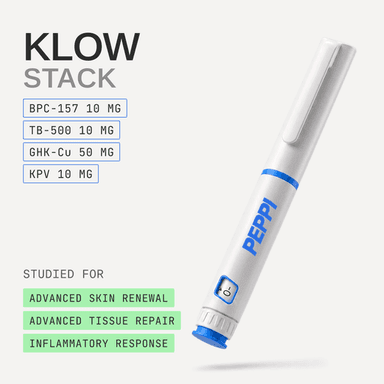
Featured pen
KLOW
BPC-157, TB-500, GHK-Cu and KPV in one ready-to-use, pre-filled pen. A clinician licensed in your state reviews your intake before anything ships.
Key takeawayAt Peppi, KPV comes in KLOW: four peptides in one clinician‑prescribed pen.
Chapter 07 of 07
KPV vs BPC-157
Different jobs, one blend
KPV and BPC‑157 are both studied for inflammation and repair, but they are different molecules with different research records. A PubMed search for this guide found no study comparing them head to head.
BPC‑157 is the larger of the two: a 15‑amino‑acid peptide based on a protein found in gastric juice. A 2025 systematic review in HSS Journal counted 36 studies, 35 of them preclinical. In animal models of muscle, tendon, ligament and bone injury, BPC‑157 improved functional, structural and biomechanical outcomes. Clinical data on how well it is tolerated were missing.
KPV's research is aimed at inflammatory signaling, mostly in the gut. That is the practical read on BPC 157 vs KPV: one is studied mainly for tissue repair, the other for inflammation.
At Peppi, the choice isn't always one or the other. Peppi's Wolverine pen pairs BPC‑157 with TB‑500, KLOW carries BPC‑157 and KPV together with TB‑500 and GHK‑Cu, and Peppi's BPC-157 pen holds BPC‑157 alone. Each pen is the right choice for someone, and a licensed clinician determines which is appropriate for you.
Getting started takes under 2 minutes online. A clinician licensed in your state reviews your intake, in most cases within 24 hours. If your prescription isn't approved, you get a 100% refund.
| Detail | KPV | BPC-157 |
|---|---|---|
| Size | 3 amino acids | 15 amino acids |
| Comes from | The hormone alpha‑MSH | A protein in gastric juice |
| Studied mainly for | Inflammatory signaling | Tissue repair in animals |
| Human research | No published trials yet | 1 small retrospective study in a 2025 review |
| In Peppi pens | KLOW only | Wolverine, KLOW, BPC‑157 & GLOW |
Not sure which recovery pen fits your goals?
Take the QuizKey takeawayInflammatory signaling is KPV's main research area, and tissue repair is BPC‑157's. KLOW carries both.
Questions about KPV
Frequently asked questions
What Does KPV Do?
In lab research, KPV lowers inflammatory signaling. It is the three-amino-acid tail of the hormone alpha-MSH, and in human cell lines it inhibited NF-kappaB, a key inflammation switch. In mice with chemically induced colitis, it reduced gut inflammation. No human trial has been published yet, so what KPV does in people is not established. Peppi offers it only in the KLOW pen.
Is KPV Better Oral or Injected?
No published study has compared oral and injected KPV in people, so neither route is proven better. Two of the mouse studies gave KPV by mouth, in drinking water. Peppi does not offer KPV capsules. Its KLOW pen is injected under the skin and holds 10 mg of KPV with three other peptides, at a dose a licensed clinician sets.
Can You Take KPV With BPC-157?
KLOW already contains both: 10 mg of KPV and 10 mg of BPC-157, with TB-500 and GHK-Cu, in one ready-to-use, pre-filled pen. Whether a combination is appropriate for you is a clinician's decision, made from your health information and goals. Ask your care team before adding anything alongside a prescription.
These peptides are not FDA-approved and are dispensed only with a prescription.
Peptide guides from Peppi
Keep reading