Your body already makes GHK‑Cu, a copper‑carrying peptide. Peppi offers it in three ready‑to‑use, pre‑filled pens, KLOW, GLOW and GHK‑Cu, and a clinician licensed in your state reviews your intake before anything ships.
Most of what is known about GHK‑Cu in people comes from skin creams. This guide walks through the skin, collagen and hair studies and who was in them, then covers dosing and where the pen fits.
The short answer
GHK-Cu is a three-amino-acid peptide bound to copper that occurs naturally in human plasma. Cream results presented at a 2002 dermatology meeting, not published as full trials, linked it to denser skin and fewer fine lines over 12 weeks in women with sun-damaged skin. Human research on injected GHK-Cu is still limited, and a licensed clinician reviews your goals and health history before deciding whether treatment fits.
- GHK‑Cu: glycine, histidine & lysine bound to copper
- Ready‑to‑use, pre‑filled pen, no mixing
- A licensed clinician sets your dose
- In 3 Peppi pens: KLOW, GLOW & GHK‑Cu
Chapter 01 of 07
What GHK-Cu peptide is
A copper-carrying tripeptide
The plain answer to what is GHK‑Cu: a small peptide made of three amino acids, glycine, histidine and lysine, bound to a copper ion. Your body makes it, and it circulates in your blood plasma.
A 2020 University of Washington review puts plasma levels at about 200 ng/mL at age 20, falling to about 80 ng/mL by age 60. The same review adds that no study has yet linked low GHK levels to a specific aging process.
GHK is the peptide alone, and GHK‑Cu is the peptide with copper attached. Labels also write it as GHK copper peptide or GHK Cu peptide.
Peppi offers it three ways. Peppi's GHK‑Cu pen holds 50 mg as a one‑month supply, and the GLOW and KLOW blends each carry the same 50 mg alongside other peptides. Peppi lists GHK‑Cu as studied for skin glow, collagen support and healthy aging.
Key takeawayYour body makes this copper tripeptide, and plasma levels fall with age.
Chapter 02 of 07
GHK-Cu benefits for skin & collagen
What the cream reports found
Most GHK Cu benefits you'll read about trace back to creams tested on women with sun‑damaged skin, plus lab work on skin cells.
A 2018 GHK‑Cu gene data review in the International Journal of Molecular Sciences summarizes the cream results. Two of them were presented at a 2002 dermatology meeting, not published as full trials. In the first, 71 women with mild to advanced photoaging used a facial cream for 12 weeks. Skin density and thickness increased, and laxity, fine lines and wrinkle depth were reduced.
In the second meeting report, 41 women with photodamage used a GHK‑Cu eye cream for 12 weeks. It performed better than a placebo and a vitamin K cream, and the review reports fewer lines and wrinkles and denser, thicker skin.
Two cautions belong next to those numbers. The review cites both from meeting proceedings, not journal papers, which leaves less detail to check. And the review's authors list a skincare company's research department as their affiliation.
On collagen, the same review reports that GHK increases collagen, elastin and glycosaminoglycan synthesis and supports dermal fibroblasts, the cells that build skin's framework. Most of that evidence comes from cell and lab studies.
Copper peptides for skin have been studied in people mainly as creams. The independent 2020 review agrees that clinical studies showed better skin condition with GHK‑Cu in a cream, and it calls for more clinical study.
| Detail | Who & how long | What was reported |
|---|---|---|
| Facial cream (2002 meeting report) | 71 women with photoaging, 12 weeks | Denser skin & fewer fine lines |
| Eye cream (2002 meeting report) | 41 women with photodamage, 12 weeks | Beat placebo & a vitamin K cream |
| Scalp spray (GHK without copper) | 45 men with pattern hair loss, 6 months | One of two strengths beat placebo on hair count change |
| Injection | Human data are limited | Mostly creams were tested so far |
Key takeawayCream results from a 2002 dermatology meeting link GHK‑Cu to denser skin over 12 weeks.
Chapter 03 of 07
GHK-Cu for hair growth
Early signals for hair
Research on GHK Cu for hair growth is at an earlier stage than the skin research, and none of the studies here used injections. The 2018 review names thicker hair and larger follicles among GHK‑Cu's reported effects without describing a human hair trial.
In a 2007 lab study, AHK‑Cu, a close relative of GHK‑Cu, made human hair follicles grow longer outside the body.
A 2016 trial in Annals of Dermatology randomized 45 men with male pattern hair loss to a once‑a‑day scalp spray: a placebo or one of two strengths of a GHK and 5‑aminolevulinic acid compound. It ran 6 months.
All three groups gained hair, placebo included, and at 6 months only the lower‑strength spray beat placebo on the ratio of change. Hair length and thickness did not differ between groups. The compound contains GHK but no copper, so it is not GHK‑Cu, and it went on the scalp rather than under the skin.
Key takeawayHair is a newer GHK research area, studied so far on the scalp and in the lab.
Chapter 04 of 07
GHK-Cu injection vs topical
Cream or pen: How they differ
GHK Cu topical products, meaning creams and serums, are where nearly all the human research sits. A GHK‑Cu peptide injection puts the peptide under the skin instead of on it, and human data on that route are limited.
For injections, Peppi's product page is direct. Research in people "is limited and mostly tested creams, not injections." The page adds that "FDA says compounded injectable GHK‑Cu may pose a risk of immune reactions." Peppi's GHK‑Cu, GLOW and KLOW pens are compounded prescription peptides and are not FDA‑approved.
Peppi does not sell creams or serums. What it offers is the injected form in a ready‑to‑use, pre‑filled pen. A licensed clinician reviews your information and determines whether treatment is appropriate for you, and that is where your health history comes in.
| Detail | Topical GHK-Cu | Peppi's GHK-Cu pen |
|---|---|---|
| Form | Cream or serum on the skin | Injection under the skin |
| Human studies | 12‑week cream reports from a 2002 meeting | Limited so far |
| Who decides | You do | A clinician licensed in your state |
| Sold by Peppi | No | Yes, by prescription |
Key takeawayPeppi's pen pairs GHK‑Cu with a prescription, a clinician and batch testing.
Chapter 05 of 07
GHK-Cu dosage
Why no chart applies
There is no established GHK‑Cu dosage for injections in people. A 2015 review by the same research group ends on that point: "Future research is needed to establish the effective dosage in humans and the best ways of delivery."
So an online dosing chart has no human dosing trial behind it. With Peppi, a clinician sets the amount. In Peppi's words, "Your dose is personalized based on your health information, goals, and treatment plan."
The pen handles the rest. Each GHK‑Cu pen holds 50 mg as a one‑month supply, and you turn the twist‑to‑dose selector to the dose on your prescription. There is no reconstituting and no mixing.
What's inside is checked before it ships. Independent labs test every batch for potency, sterility, pH and endotoxicity, and potency is the test that verifies the labeled amount. Your lot number is printed on the pen label, so you can look it up in Peppi's batch test results.
Good to knowFound a GHK-Cu dosing chart online? Don't use it to set or change a dose. Message your care team first.
Key takeawayYour clinician sets your dose, and the pen delivers it without math.
Chapter 06 of 07
GHK-Cu before & after timeline
Think in months
No published trial has timed results for GHK‑Cu injections, according to Peppi's product page, and response varies from person to person.
The closest reference points are the cream results presented at a 2002 dermatology meeting, which reported skin changes after 12 weeks of use. That is a timeline for creams on the face, not for a pen.
Photos labeled GHK‑Cu peptide injection before and after are easy to find online. A photo can't account for lighting or other skincare.
Peppi's own guidance is about patience: "Peptide therapy is cumulative. We recommend patients commit 4‑6 months for results to build." One verified buyer, Sarah T., wrote:
“I originally got GHK-Cu for some lingering skin texture issues. It took a month or two, but my face feels significantly plumper and the fine lines look softer. A surprise bonus was that my hair actually started feeling a lot thicker at the roots, too.”
Good to knowThat's one person's experience, not a typical result, and results vary. Peppi's Terms state that no particular cosmetic or wellness outcome is guaranteed.
Key takeawayThink in months. Peppi recommends 4 to 6 for results to build.
Chapter 07 of 07
GHK-Cu in the GLOW & KLOW blends
One peptide, three pens
Three Peppi pens carry GHK‑Cu, and what changes is the company it keeps. Peppi's KLOW pen holds it with three other peptides: BPC‑157, TB‑500 and KPV. Its three‑peptide sibling, the GLOW peptide pen, leaves out KPV, and the GHK‑Cu pen holds the peptide alone.
Peppi lists GLOW as studied for skin and collagen support, repair and recovery, and healthy aging. KLOW, the four‑peptide blend, is listed as studied for advanced skin glow, advanced tissue repair and anti‑inflammatory. Each blend holds the same 50 mg of GHK‑Cu as the single pen.
The evidence note carries over. Peppi's GLOW page says it found no published study testing the three peptides together, and the KLOW page says no trial has tested the KLOW blend itself in people. Read each blend as separately studied parts in one pen.
Which pen fits depends on your goals. KLOW adds KPV, a peptide studied for inflammation in cells and mice, to GLOW's three. Skin plus recovery support points to GLOW. Skin and collagen alone point to GHK‑Cu. A licensed clinician makes the final call.
Starting takes under 2 minutes online. A clinician licensed in your state reviews your intake, in most cases within 24 hours. If your prescription isn't approved, you get a 100% refund.
| Detail | In the pen | Price |
|---|---|---|
| KLOW | BPC‑157 10 mg, TB‑500 10 mg, GHK‑Cu 50 mg, KPV 10 mg | $449 one time, or 50% off your first month by subscription |
| GLOW | BPC‑157 10 mg, TB‑500 10 mg, GHK‑Cu 50 mg | $379 one time, or 50% off your first month by subscription |
| GHK-Cu | GHK‑Cu 50 mg | $299 one time, or 50% off your first month by subscription |
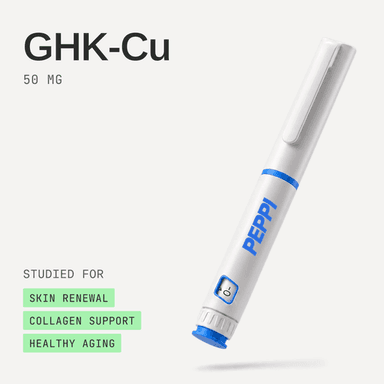
Featured pen
GHK-Cu
50 mg of GHK-Cu in a ready-to-use, pre-filled pen, with a twist-to-dose selector you turn to the dose on your prescription.
Not sure which pen fits your skin goals?
Take the QuizKey takeawayThe same 50 mg of GHK‑Cu in three pens. Your goals decide which one fits.
Questions about GHK-Cu
Frequently asked questions
What Does GHK-Cu Do for Skin?
In 12-week cream results, GHK-Cu was linked to denser skin and fewer fine lines. A 2018 review describes a facial cream used by 71 women with sun-damaged skin that reported those changes. That result was presented at a 2002 dermatology meeting, not published as a full trial. Lab work points to collagen and elastin production. Human data on injected GHK-Cu are limited.
How Long Does GHK-Cu Take to Work?
No published trial has timed results for GHK-Cu injections, according to Peppi's product page. The cream results behind most skin claims, presented at a 2002 dermatology meeting and not published as full trials, reported changes after 12 weeks of use. Peppi notes that peptide therapy is cumulative and recommends that patients commit 4 to 6 months for results to build. Response varies from person to person, and no outcome is guaranteed.
Where Do You Inject GHK-Cu?
Peppi's pens are injected under the skin. Peppi's How to use page names three areas, the same three as the MedlinePlus guide to subcutaneous injections: the belly, the outer thigh and the upper arm. Your clinician's instructions and the guide that comes with your pen always come first, so follow those if they differ from anything you read online.
These peptides are not FDA-approved and are dispensed only with a prescription.
Peptide guides from Peppi
Keep reading